

Certified Solar Technician Career Guide & Training Path
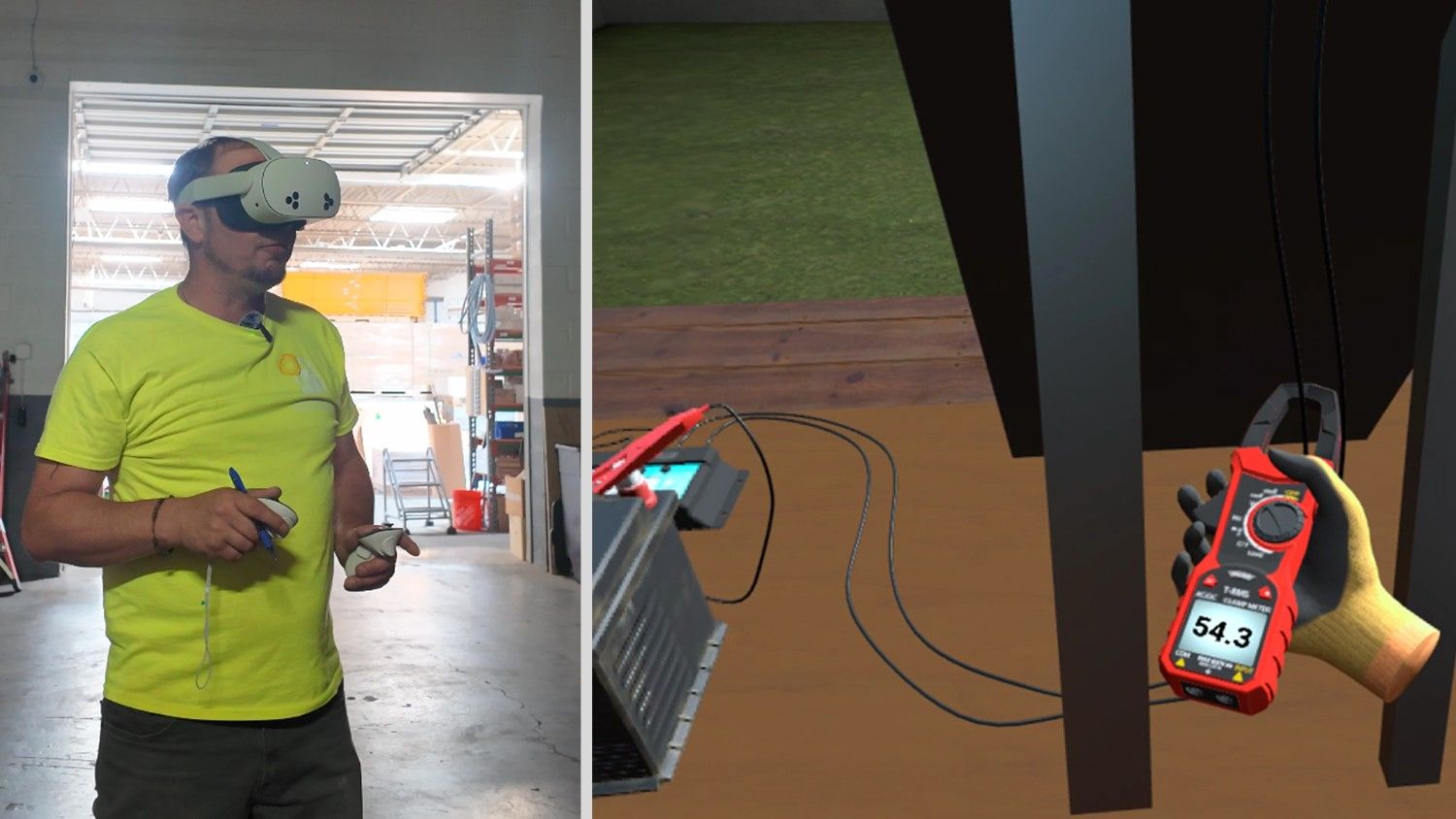
Introduction:
The solar energy sector is expanding rapidly, with record levels of panel installations every year. As renewable energy becomes the fastest growing power source globally, the demand for a Certified Solar Technician is increasing quickly. At the same time, companies are actively hiring, but there is still a shortage of skilled professionals.
This skill gap is supported by data. According to the IREC National Solar Jobs Census 2024, over 86% of employers report difficulty finding qualified workers. This means there are more technician job openings in this field than trained candidates. If we are planning to enter the renewable energy sector or skilled trades, this is a strong opportunity with consistent demand.
Another key advantage is accessibility. We do not need a college degree or years of experience to start. With the right solar technician training, recognized certification, and practical knowledge of photovoltaic (PV) systems and installation, we can become job ready in about 3 to 6 months.
In this guide, we will cover everything we need to know about becoming a Certified Solar Technician, including job role, career path, salary, and a clear step by step process to get certified and start working.
What Is a Certified Solar Technician?
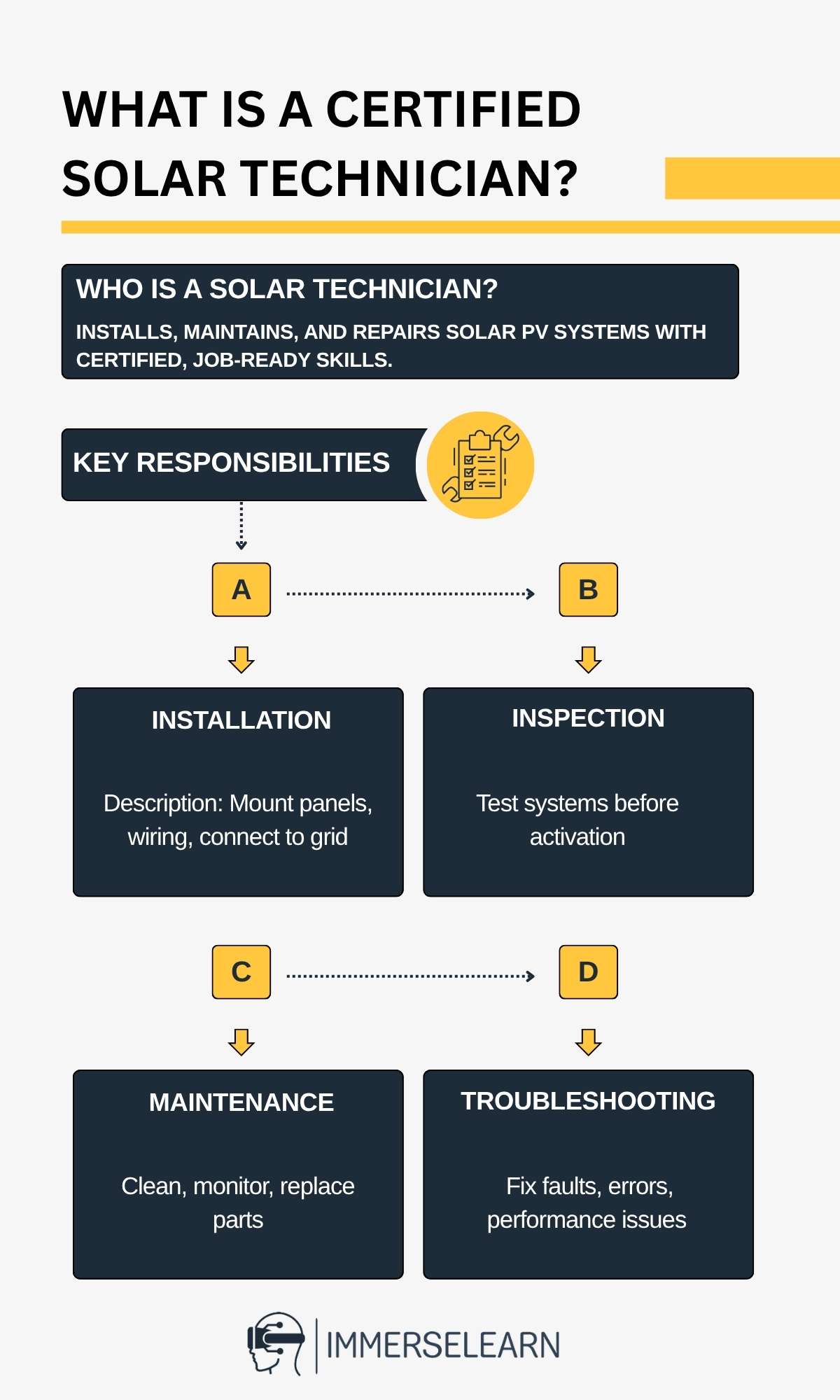
A Certified Solar Technician is a trained professional who installs, inspects, maintains, and troubleshoots solar PV systems. We also hold a verified certification from a recognized body, which confirms our technical skills and readiness to work in the solar energy industry.
It is important to understand the difference between trained, certified, and licensed. These terms are often confused but have very different meanings in the renewable energy sector.
- Trained: We have completed a solar technician training program, but there is no third party verification. On its own, this is usually not enough for most employers.
- Certified: We have passed a formal assessment from a recognized body. This is what most employers look for, as it proves our skills are tested and verified.
- Licensed: This refers to a legal permit required in some regions to work on grid connected systems. Requirements vary by location, so we should always check local regulations before starting work.
Solar Technician Roles and Responsibilities
As a Certified Solar Technician, we work across four key areas to keep photovoltaic (PV) setups running safely and efficiently in real world conditions.
- Installation: We manage panel installation by mounting them on rooftops or ground mounted structures. We also connect them to inverters and integrate the setup with battery storage or the electrical grid to ensure proper energy flow.
- Inspection: Before activation, we carry out detailed inspections. This includes testing electrical connections, checking safety standards, and ensuring performance matches the original design specifications.
- Maintenance: We perform regular upkeep, including panel cleaning, performance monitoring, and component checks. We also replace worn out parts to maintain efficiency and long term reliability.
- Troubleshooting: We identify and fix issues such as inverter faults, wiring problems, and shading impact. By diagnosing the root cause, we ensure optimal performance and consistent energy output.
Is This Career Path Right for You?
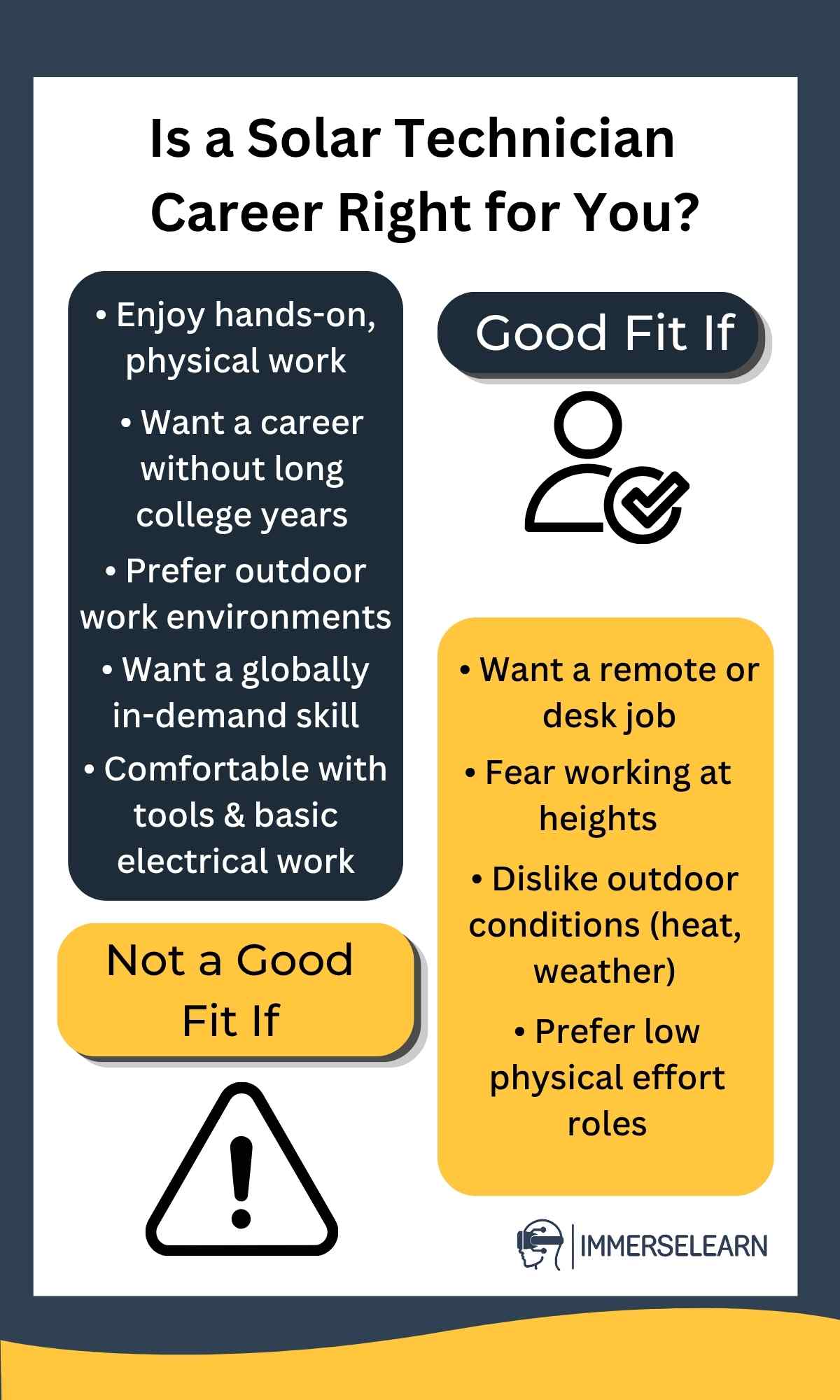
A Certified Solar Technician career suits those of us who enjoy physical, outdoor, hands on work and want quick entry into the renewable energy industry. With the right solar technician training and certification, we can start within months instead of years.
Before we commit, we should check if the daily work matches our lifestyle and preferences.
Strong Fit for Solar Technician Career:
- Enjoy physical and hands on work and can stay active throughout the day
- Want to enter a stable career path without spending years in college
- Prefer working outdoors on rooftops, industrial sites, and real job locations
- Want a skill with global demand as solar energy systems continue to expand
- Are comfortable using tools, handling basic electrical systems, and following technical instructions
When This Career May Not Be Suitable:
- Need a remote or desk based work environment
- Are not comfortable working at heights
- Find it difficult to work in heat or changing outdoor conditions
- Prefer roles with minimal physical effort
Skills Required to Become a Certified Solar Technician
To become a Certified Solar Technician, we need a mix of technical, physical, and practical skills. We can enter the renewable energy industry without a college degree through proper solar technician training.
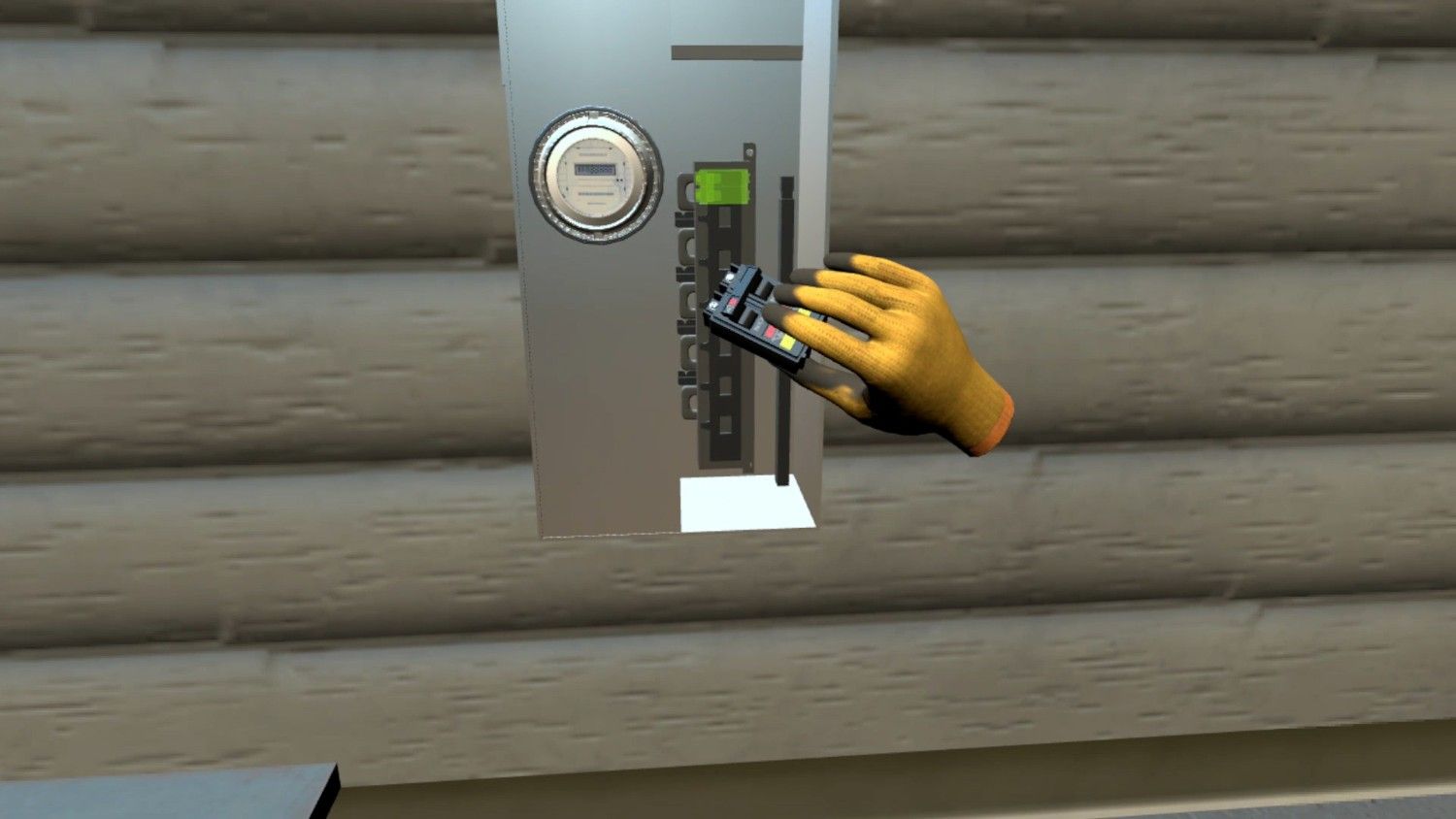
On the technical side, we should understand wiring, voltage, circuits, and safety. We also learn how photovoltaic systems work, including panels, inverters, and battery storage, along with hands-on practice in panel installation, testing, and using tools like multimeters. Our AC voltage testing training for solar PV systems covers this hands-on meter work.
Physical readiness is essential. We need to be comfortable working at heights, handling equipment, and managing outdoor conditions.
Practical abilities include attention to detail, problem solving, communication, and reliability on job sites.
We do not need to master everything at the start. A structured program helps us build these abilities step by step and prepare for real world solar energy system work.
Industry Insights on Solar Training and Workforce Demand
The best way to understand a Certified Solar Technician career is to learn from professionals already working in the renewable energy sector. Most successful technicians start with little or no experience and build expertise through structured technician training programs.
Experts highlight that basic electrical knowledge is helpful but not essential. What matters more is hands-on experience with photovoltaic systems, practical exposure, and a strong focus on safety from the start.
We should also consider the physical nature of the job. Working on rooftops, handling heat, and spending long hours on site are common. Many beginners struggle more with these conditions than with technical abilities.
From a hiring perspective, candidates with certification and hands-on experience in panel installation are preferred. Certification helps us enter the field, but practical confidence supports long term growth.
Training providers emphasize that accredited programs produce more job ready professionals than theory based learning. Choosing the right technician training program is important for building a successful career.
Salary for Certified Solar Professionals
The solar energy industry is facing a labor shortage, which is increasing pay for a Certified Solar Technician. As demand grows, we can expect competitive salaries across all levels in the renewable energy sector, with strong growth as skills and certifications improve.
Salary by Experience Level:
Earnings increase as we gain experience and move into specialized roles such as photovoltaic system maintenance, troubleshooting, and advanced panel installation. On average, a Certified Solar Technician can see a salary increase of $15,000 to $30,000 when progressing into technical roles.
| Experience Level | Yearly Salary (Avg.) | Hourly Rate (Avg.) |
| Entry Level (bottom 10%) | below $39,070 | ~$18.78 |
| Mid Level (Median) | $51,860 | $24.93 |
| Senior / Top Earners (Top 10%) | above $80,150 | ~$38.53 |
How Certification Impacts Earnings
Certification plays a key role in increasing earning potential in the solar technician career. The NABCEP credential is widely recognized as an industry benchmark and helps us access higher paying opportunities in the renewable energy sector.
- Credential impact: Around 70% of professionals who earned NABCEP certification while employed reported a salary increase after completing it (HeatSpring NABCEP Candidate Survey).
- Access to advanced work: As a Certified Solar Technician, we are more likely to work on grid connected systems, inverters, and battery storage troubleshooting, which are more technical and higher paying roles.
- Hiring preference: Many employers prefer or require certification for commercial and large scale solar projects, making it easier for certified candidates to secure better opportunities.
In simple terms, certification increases both our earning potential and the range of work we can take on. It helps us move from entry level positions into more stable and higher paying roles in the solar energy industry.
How to Become a Certified Solar Technician (Step by Step)
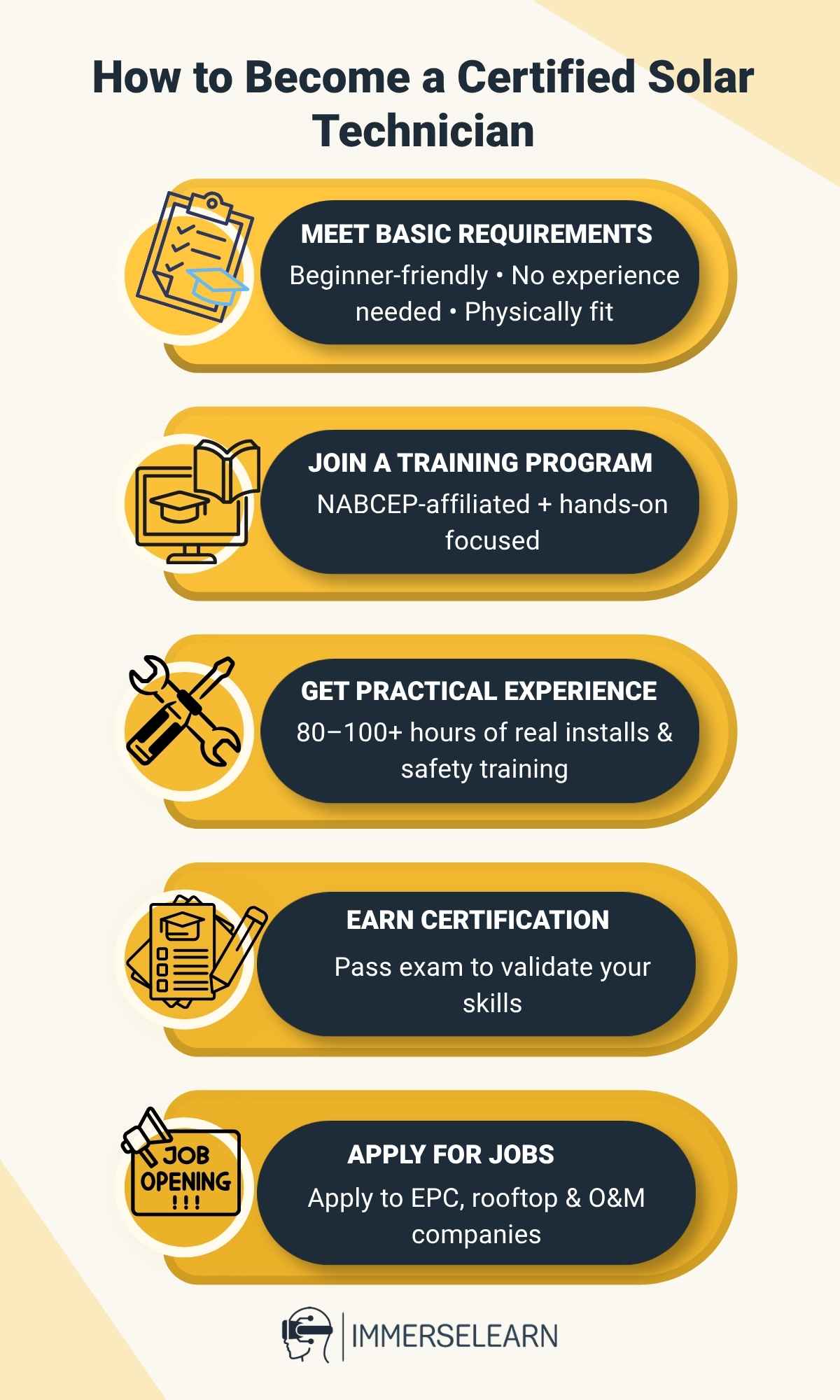
Becoming a Certified Solar Technician is a practical process focused on real skills, not just theory. By following the right path, we can move from beginner to job ready in a structured way aligned with expectations in the renewable energy industry.
1) Meet Basic Entry Requirements:
Starting a solar technician career is beginner friendly and accessible. Most training programs require a high school diploma or equivalent (GED), while advanced courses may prefer additional technical training or prior coursework in electrical or mechanical fields. There is no strict age limit, so we can start at any stage.
Since this is a hands on role, we should be comfortable working at heights, lifting equipment, and handling outdoor conditions. No prior experience is needed, as training covers the basics of photovoltaic systems and installation.
2) Enroll in a Recognized Solar Training Program:
Choosing the right solar technician training program is important because employers prefer accredited learning. We should select programs that include panel installation, PV system design, safety standards, and real system testing rather than only theory.
| Path | Duration | Best For |
| Fast Track | 3 to 6 Months | Career Changers |
| Standard | 6 to 12 Months | Beginners |
| Part-Time | 12 to 18 Months | Working Pros |
The right program can significantly reduce your learning curve and improve job readiness. If you're comparing options, you can explore a structured online solar technician training program that builds both theory and practical skills.
3) Gain Hands On Practical Experience:
This is the stage where many beginners either become job ready or struggle later. Employers can quickly tell whether we have real experience working on solar energy systems or only theoretical knowledge.
Essential elements of effective training:
- Live solar panel installation on training setups or real rooftops
- Supervised wiring, system testing, and fault diagnosis
- Safety practices including fall protection, arc awareness, and electrical safety procedures
- Site exposure to understand real installation environments
Practical experience builds confidence and helps us adapt faster when we start working as a Certified Solar Technician.
4) Earn Solar Technician Certification:
After completing training, we need to pass a certification exam to become a Certified Solar Technician. The exam usually includes theory, practical assessment, and sometimes verbal evaluation.
Key details to keep in mind:
- Exam formats may vary depending on the certification body
- We should always keep digital and physical copies of our certification
- Renewal may be required every few years through continued learning
Certification validates our skills and increases our competitiveness in the renewable energy industry.
5) Apply for Solar Jobs or Apprenticeships:
Once certified, we can start applying for entry level roles in the solar energy industry. Common employers include installation companies, EPC firms, and maintenance service providers.
We can apply through platforms like Indeed, LinkedIn, and industry specific job portals.
Resume essentials:
- Highlight our Certified Solar Technician credential and training hours
- Mention tools and equipment we have used, including inverters and testing devices
- Clearly state that we are entry level but trained and job ready
Employers value reliability, willingness to learn, and hands on exposure more than prior experience. Training programs with placement support can help us enter the workforce faster.
Top Certifications for Solar Technicians
When we aim to become a Certified Solar Technician, choosing the right certification is important because not all credentials have equal value in the renewable energy industry. Employers prefer certifications that are recognized, practical, and aligned with real job requirements.
Here are some of the most respected credentials that help us stand out in a competitive technician career:
- NABCEP PV Associate / PV Installation Professional: This is widely considered the industry gold standard. It builds credibility and improves our chances of getting hired faster in panel installation and advanced system roles.
- IREC ISPQ Accredited Programs: These programs follow industry standards and are often required for utility supported projects and large scale energy systems, making them valuable for advanced roles.
- City and Guilds 2399: This credential is a recognized benchmark for photovoltaic systems installation and demonstrates strong technical competency in system setup and performance.
What Makes a Good Certification:
Not every credential delivers real career value. We should focus on options that are:
- Backed by a recognized organization
- Include hands on assessment, not just theory exams
- Recognized by employers in our target job market
Before enrolling, we should also check which companies hire graduates from the program. If there is no clear answer, it may be a warning sign.
Best Solar Technician Training Programs
The right course is essential to become a Certified Solar Technician. A quality technician development program bridges basic knowledge and job readiness in the renewable energy sector.
The best programs cover photovoltaic systems, including design, panel installation, troubleshooting, safety practices, and system maintenance with real world hands-on practice.
Many industry-recognized programs are built with employers and accredited institutions. You can explore an online solar training program that combines structured learning with hands-on practice.
Online vs Offline Training: Which Is Better?
Choosing between different learning formats depends on our schedule, learning style, and career goals as a Certified Solar Technician.
| Aspect | Online | Offline |
| Flexibility | Online Training is self paced and accessible anywhere | Offline Programs Follow fixed in person schedules |
| Hands-On | Online uses VR Simulations and externships | Offline offers live rooftop and lab based training |
| Cost | Online Programs are more affordable | Offline may include travel and accommodation costs |
| Speed | 3-6 months fast-track Possible | 6-12 months standard |
| Best For | Online suits fast entry and career changers | Offline suits those who prefer classroom learning |
Industry insights show that virtual programs with strong practical components can match traditional outcomes. While remote learning improves accessibility, real world exposure remains essential to becoming a job ready Certified Solar Technician.
How to Choose the Right Solar Training Program
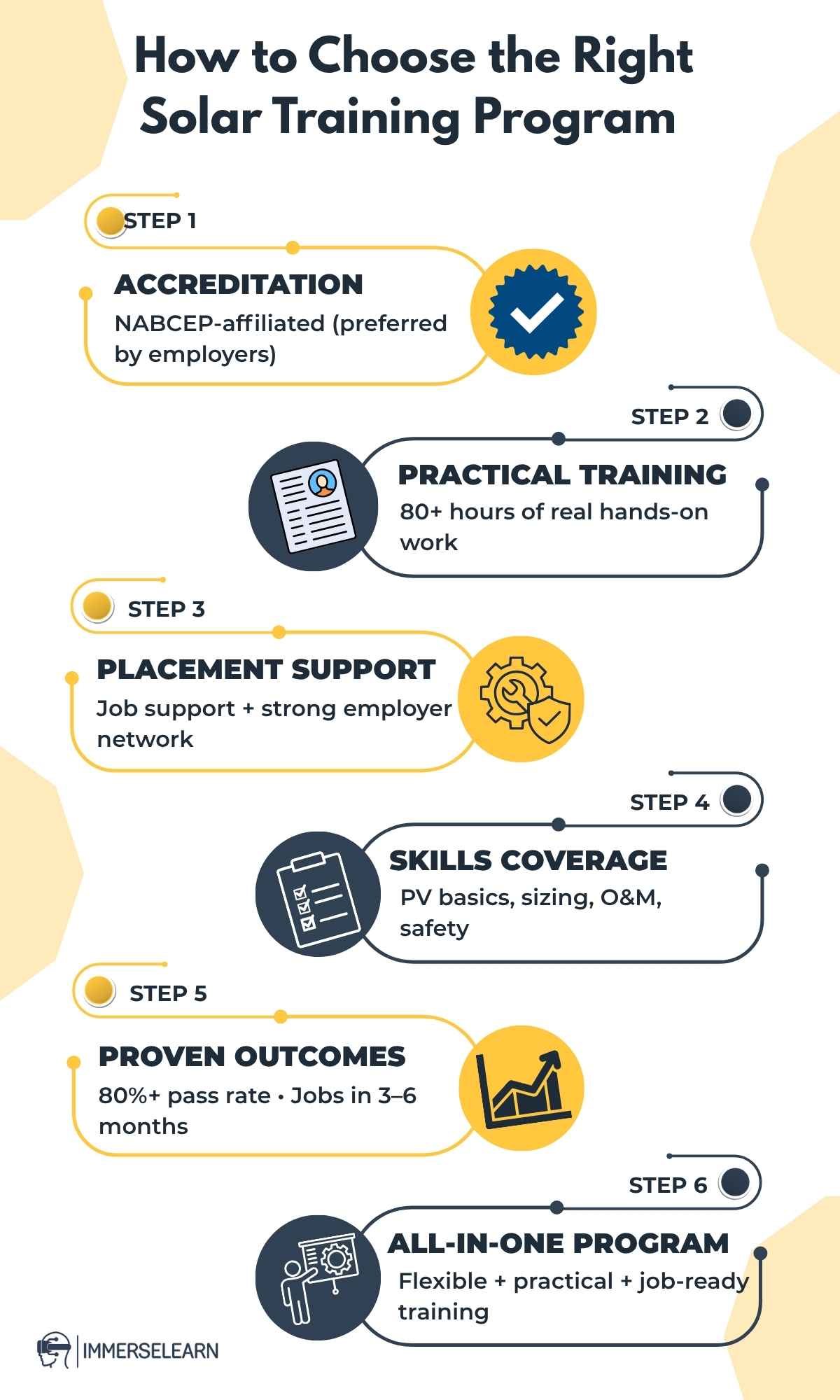
To become a Certified Solar Technician, we should select a course that meets real industry standards. Employers prefer candidates from proven technician development pathways aligned with renewable energy requirements.
- Accreditation: Choose NABCEP aligned or equivalent credentials preferred by top employers
- Practical Exposure: Look for 80 plus hours of hands on learning in panel installation, wiring, and safety, including VR simulations and externships
- Placement Support: Learning pathways should offer resume help, mock interviews, and employer connections with clear graduate placement data
- Skills Coverage: Curriculum should include photovoltaic systems, system sizing, commissioning, maintenance, and safety certifications like OSHA
- Outcomes Proof: Check certification pass rates and average time to employment for transparency
Example: Programs from providers like ImmerseLearn offer NABCEP PV Associate exam preparation with practical hours and career support.
Cost to Become a Certified Solar Technician
The total investment to become a Certified Solar Technician usually ranges from $3,000 to $8,000. This includes technician preparation courses, certification exam charges, and basic equipment needed to enter the renewable energy sector.
Program costs typically range from $2,000 to $6,000. Most learning packages include digital study materials, platform access, and sometimes practical kits or VR based modules for photovoltaic systems.
Certification exams usually cost $300 to $800. For example, the NABCEP PV Associate credential is around $400, including application and assessment charges, and it is widely recognized in the renewable energy field.
If required, essential equipment and safety gear may add another $200 to $500. Many learning providers include these within the package, helping us start without extra financial burden.
How quickly training pays off depends on your role, location and pay. We should choose programs that clearly explain what is included, such as exam charges, equipment, safety certification, and hands-on learning.
Job Opportunities After Certification
After becoming a Certified Solar Technician, we gain access to multiple job roles in the growing renewable energy sector. With the right solar technician training and certification, we can start working quickly and build long term career growth.
Entry Level Solar Technician Jobs:
- Solar panel installer: We work on residential and commercial installation projects for photovoltaic systems.
- Junior technician: We assist in larger PV system installations on commercial and industrial sites.
- O and M assistant: We monitor system performance, clean panels, and support efficient energy output in operations and maintenance work.
- Site helper or solar assistant: We gain hands-on experience and gradually grow into a full technician role in the renewable energy field.
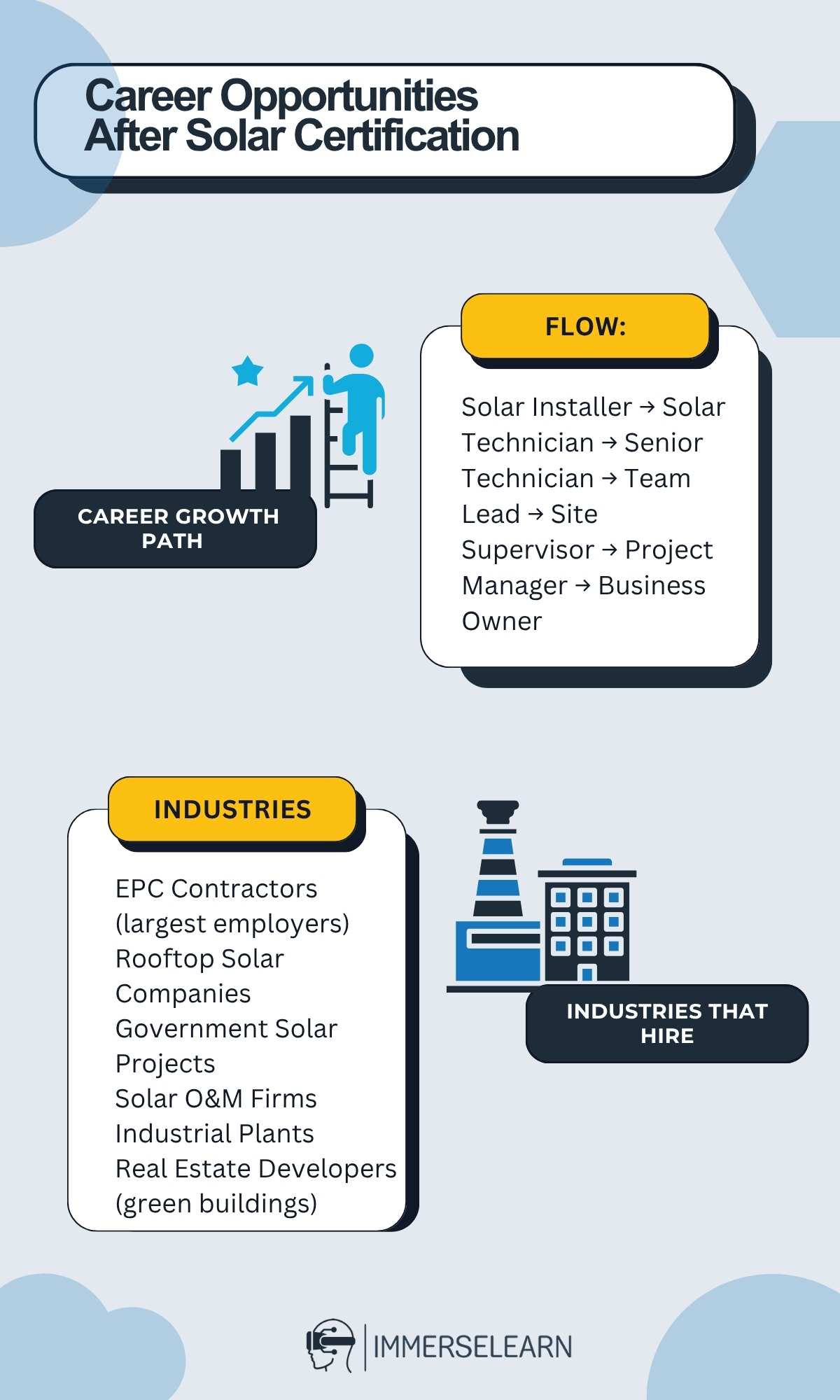
Career Growth Path in Solar Industry:
With experience, we can progress through a clear career path: Installer → Technician → Senior Technician → Team Lead → Site Supervisor → Project Manager → Business Owner.
As certified professionals, we can also move into system design, sales engineering, or start our own installation business. Early technical knowledge supports long term growth in the renewable energy industry.
Industries Hiring Professionals in This Field:
- EPC contractors in the renewable energy sector
- Rooftop installation companies
- Government clean energy projects and public sector programs
- Operations and maintenance service companies
- Industrial plants using captive renewable power systems
- Real estate developers focused on green and sustainable infrastructure
Future Scope of Solar Technician Jobs
We are witnessing a major shift toward clean power solutions, making photovoltaic technology one of the fastest growing job markets globally. According to the International Energy Agency Renewables 2025 report, solar PV is expected to contribute nearly 80 percent of the global increase in clean power capacity through 2030. This growth will require a skilled workforce for panel installation, system operations, and maintenance across multiple regions.
Insights from the International Renewable Energy Agency also confirm rising demand for solar technicians as adoption of clean energy expands worldwide. Beyond new installations, long term opportunities will include system maintenance, performance monitoring, and upgrades, creating stable and future proof careers in the solar energy sector.
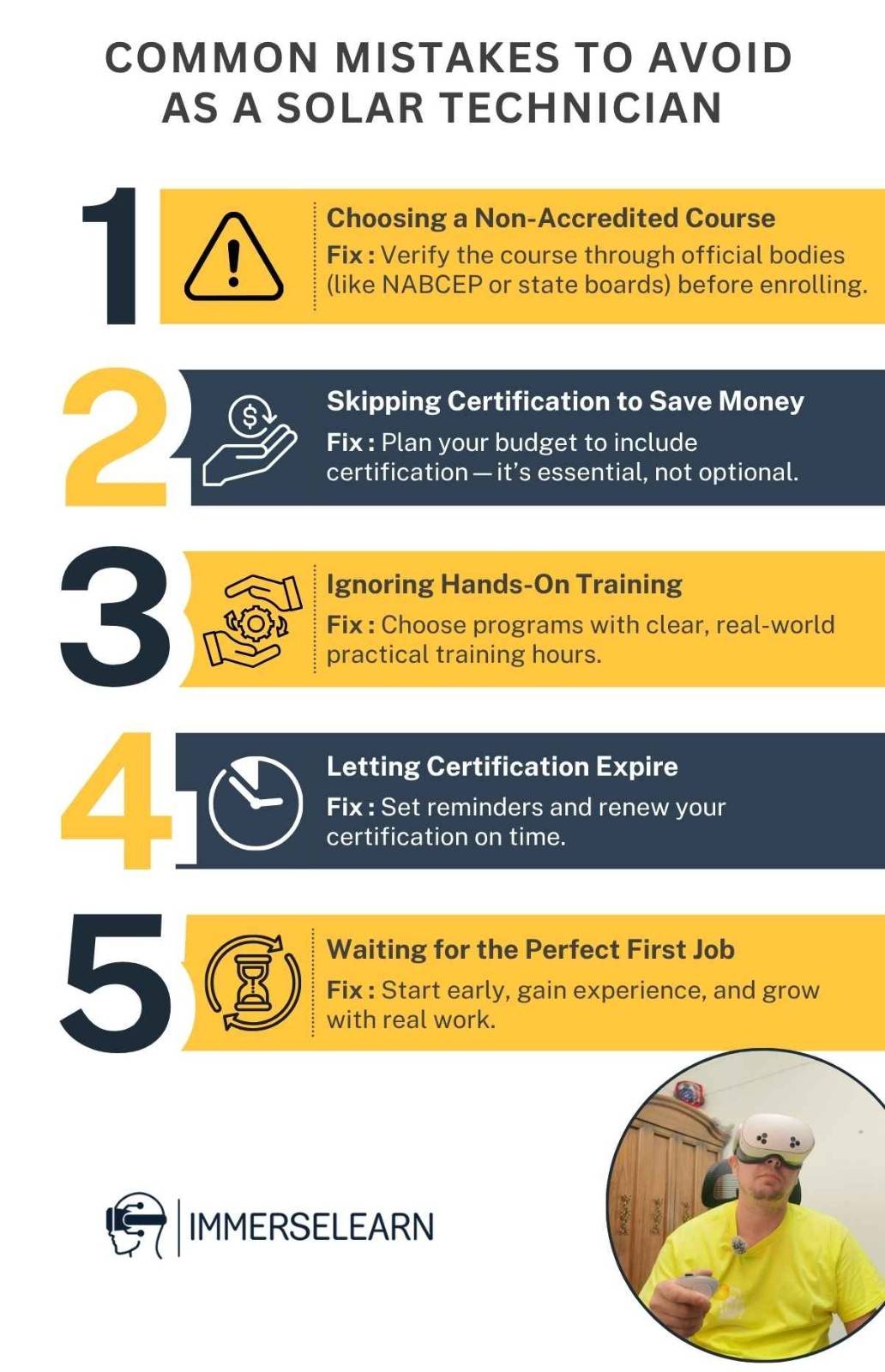
Common Mistakes to Avoid in Solar Technician Career
1. Choosing a Non Accredited Course:
We may complete training and feel confident, but employers prioritize recognized certification bodies. If the program is not accredited, our application can be rejected.
Fix: Before you enroll, check whether a course prepares you for a NABCEP exam and what NABCEP requires to sit for it.
2. Skipping Solar Certification to Save Money:
Training alone is not enough because many employers require proof of skills. Without proper solar technician certification, job opportunities and salary potential reduce significantly.
Fix: We should plan certification costs from the start. It is essential for building a career in the solar energy industry.
3. Ignoring Hands On Training:
We may learn theory through tutorials, but solar panel installation requires real site experience. Employers quickly notice lack of hands-on skills, which also affects safety and hiring chances.
As noted by Johanna Fleischman, Program Advisor for Photovoltaic training at ImmerseLearn, skipping practical training can create false confidence that fails in real job conditions.
Fix: We should check practical training hours before enrolling. If they are unclear or zero, we should choose a better program.
4. Letting certification expire:
Certifications have renewal deadlines. Missing them can lead to loss of job opportunities, projects, or compliance eligibility.
Fix: We should set renewal reminders immediately after certification. It takes little time but protects our solar technician career continuity.
5. Waiting Too Long for First Job:
The first job does not need to be perfect. Delaying entry into the field slows learning and career growth.
Fix: We should start early, gain experience, and build confidence through real work. In the renewable energy industry, experience matters more than perfection.
Frequently Asked Questions (FAQs):
Q1) How long does it take to become a certified solar technician?
Ans: We can enter this career path in 3 to 12 months depending on our schedule and training format. Fast track programs take around 3 to 6 months, while part time learning may take up to 12 to 18 months including certification completion.
Q2) Is certification mandatory to get a solar job?
Ans: Legally it may not always be required for basic work, but in practice employers strongly prefer solar technician certification. It proves job ready skills.
Q3) Can we become a solar technician through online training only?
Ans: Online training helps us learn theory, but real solar panel installation requires hands-on practice. To become job ready, we need exposure to panels, inverters, and wiring. Hybrid programs with practical training are the most effective.
Q4) Is solar technician a good career?
Ans: Yes. Demand for skilled professionals in this field is rising due to renewable energy growth and government support. The work is physically demanding, but it offers stable long term career growth and strong earning potential.
Q5) What is the starting salary in this field?
Ans: Salaries depend on location and experience, but beginners earn within the skilled trades range in their region. With experience and certification, income can increase significantly over time.
Q6) Do we need a degree to become a solar technician?
Ans: No degree is required. Most training programs need only basic education. This is a skill based career focused on PV systems, safety standards, installation, and maintenance work.
Conclusion:
Solar power is not a short term trend. It is becoming a dominant force in the global power sector and is projected to be the largest source of electricity by the early 2030s. Demand for Certified Solar Technicians is also rising faster than supply, creating strong opportunities in the renewable energy industry.
We do not need a four year degree or prior experience to start. We only need a structured PV technician training program, hands on practical experience, and a recognized certification to validate our skills.

Key data shows:
- 42 percent job growth projected for solar PV installers between 2024 and 2034
- Median salary of about $51,860 per year for photovoltaic system installers
- Around 4,100 job openings expected each year through 2034
- Only 3 to 6 months required to become job ready through fast track training programs
The pathway is simple when followed correctly: accredited training → practical experience → certification → entry level job → career growth.
If we stay consistent and follow each step, becoming a certified professional in this field is a practical and achievable career in the clean energy sector.
The real question is whether we are ready to start with the right training program today.
Sources & References:
- U.S. Bureau of Labor Statistics (BLS), Occupational Outlook Handbook: Job growth projections (42%), median wage ($51,860), and annual openings (~4,100) for Solar PV Installers, 2024 to 2034.
- U.S. Bureau of Labor Statistics (BLS), Occupational Employment & Wage Statistics (May 2024): Entry-level, mid-level, and senior wage percentile data for Solar PV Installers.
- International Energy Agency (IEA): Solar PV accounts for ~80% of global renewable capacity growth through 2030.
- IREC, National Solar Jobs Census 2024: 86% of U.S. solar employers report difficulty hiring qualified workers; certification gap data.
- NABCEP, North American Board of Certified Energy Practitioners: Official certification standards, exam formats, and renewal requirements.
- HeatSpring, NABCEP Candidate Survey: 70% of professionals who earned NABCEP certification while employed received a salary increase.