
Internal Combustion Engine Training for Hybrid Vehicle


Credits : 0.4


About the Course:
This Internal Combustion Engine in Hybrid Vehicles VR Training microcredential provides a comprehensive overview of how ICE technology is adapted and integrated within modern hybrid electric vehicles (HEVs), forming a critical foundation for hybrid vehicle technician training. Learners explore the historical development of ICEs, their function within hybrid powertrains, and their interaction with key systems such as electric motors, battery packs, and control modules.
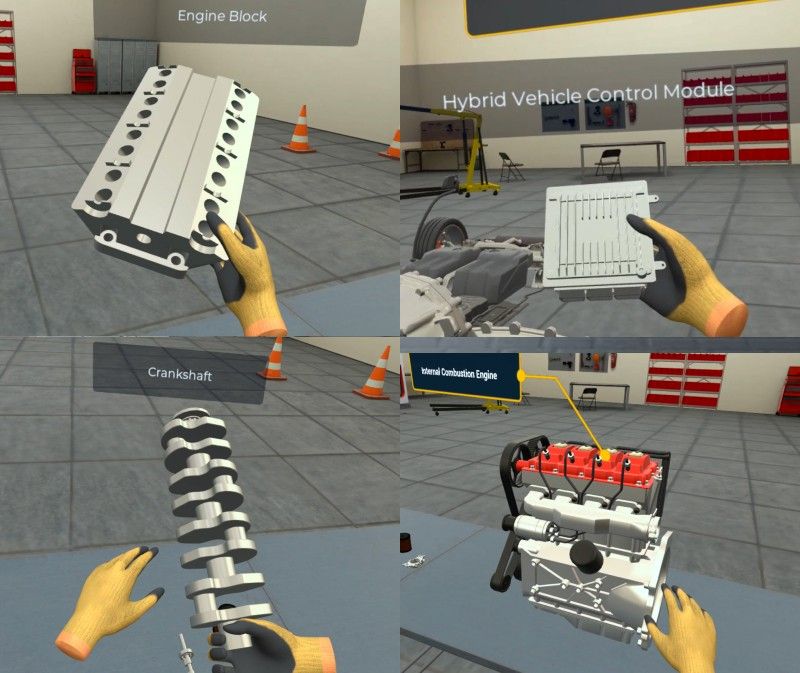
Emphasis is placed on ICE integration in hybrid vehicles, engine design considerations, operational strategies like start-stop and load sharing, and techniques for improving fuel efficiency. Virtual Reality (VR) simulations enhance learning with immersive 3D modules of ICE components, hybrid diagnostics, and hybrid-specific configurations, allowing learners to gain practical mastery of hybrid propulsion systems.
Learning Objectives:
- Understand the historical evolution of ICE technology and its adaptation to hybrid systems.
- Identify the placement and design considerations of ICEs in hybrid vehicle layouts.
- Describe key operating modes of ICEs in HEVs, including start-stop and load-sharing strategies.
- Recognize the integration of ICEs with electric motors, inverters, and power control units.
- Apply fuel efficiency techniques and emissions reduction strategies in hybrid ICE operation.
- Define the role of ICE as a primary or secondary power source in different hybrid architectures.
Course delivered through our LMS and accessible in both VR and web. Learn on the web anytime, or enjoy immersive VR training with your own Oculus VR headset.
Workforce Development

At ImmerseLearn, we prepare hybrid vehicle technicians for the complexity of dual-power systems and integrated propulsion technologies. This course emphasizes both mechanical fundamentals and hybrid-specific system knowledge, enabling learners to contribute confidently to hybrid vehicle assembly, diagnostics, and optimization.
By completing this microcredential, students are prepared to work safely and effectively with hybrid internal combustion engines, contributing to the service and optimization of advanced hybrid electric vehicles. Learners can continue through a structured HEV technician learning pathway focused on hybrid diagnostics and system integration.