
Replacing Faulty Battery in EV Training


Credits : 0.3

About the Course:
This Replacing Faulty Battery in EV microcredential trains technicians to safely diagnose, remove, replace, and verify faulty battery systems within electric vehicles (EVs).
Learners will perform real-world service procedures including identifying battery faults, isolating high-voltage systems, disconnecting battery modules, removing damaged or degraded batteries, installing replacement battery packs, and verifying system functionality using diagnostic tools. The course emphasizes electrical safety, proper handling of high-voltage components, manufacturer-recommended replacement procedures, and post-repair system validation to ensure safe and reliable EV operation while reinforcing skills taught in our EV battery assembly training program focused on battery system assembly, testing, packaging, and EV diagnostic workflows.
Learning Objectives:
- Identify signs and symptoms of faulty or degraded EV battery systems
- Safely prepare electric vehicles for battery replacement using proper shutdown and lockout/tagout procedures
-
Use diagnostic tools to verify battery faults and determine replacement requirements
- Disconnect and remove faulty battery packs while following high-voltage safety standards
- Inspect battery housing, connectors, cooling systems, and wiring for damage or contamination
- Install replacement battery systems according to manufacturer specifications
- Reconnect and calibrate battery management systems (BMS) after installation
- Verify proper battery operation, charging performance, and vehicle functionality after replacement
This Replacing Faulty Battery in EV training is delivered through our LMS and is available as both web-based and immersive VR training.
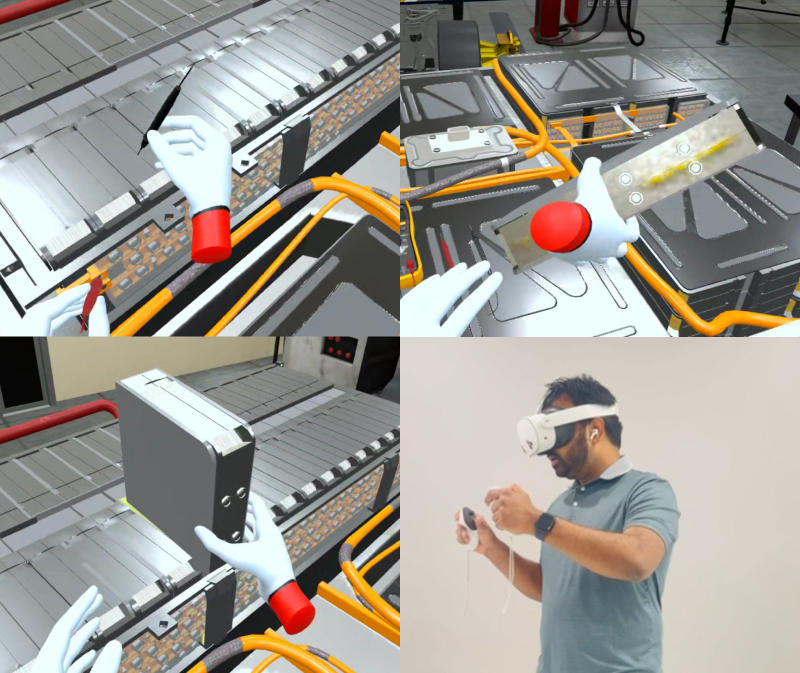
Replacing Faulty Battery in EV Training for EV Technicians

At ImmerseLearn, we equip electric vehicle technicians with critical battery service and replacement skills required for modern EV maintenance and repair. This microcredential strengthens high-voltage safety practices, diagnostic accuracy, and battery handling procedures through immersive VR-based learning while complementing our hands-on EV battery technician training, where students develop practical experience in EV battery assembly, testing, packaging, and battery management system workflows.
By completing this microcredential, technicians will gain the confidence and technical expertise needed to safely replace faulty EV battery systems, restore vehicle performance, and maintain safe and reliable operation of electric vehicles.