
Adult CPR Emergency Response Training


Credits : 0.3
About the Course:
Adult CPR Emergency Response is a critical life-saving skill for Nursing Assistants in hospitals, long-term care facilities, rehabilitation centers, and other healthcare settings. In this microcredential, learners explore the purpose of Cardiopulmonary Resuscitation (CPR) and its role in responding to cardiac arrest by maintaining blood circulation and oxygen delivery.
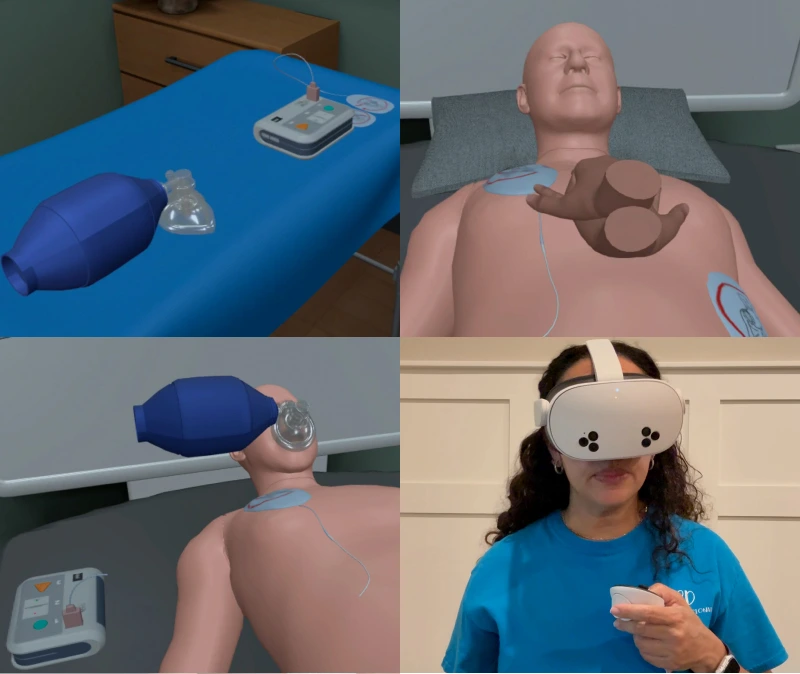
Through immersive VR simulations, learners practice Adult CPR using proper emergency response procedures, pulse assessment, chest compressions, rescue breathing, and airway management. The course emphasizes rapid response, correct compression technique, effective ventilation, and patient safety.
Learners also practice identifying cardiac arrest, performing accurate CPR cycles, using CPR valve masks, and responding until advanced medical help arrives. The course reinforces professionalism, emergency preparedness, and adherence to established CPR guidelines.
To build broader patient care and emergency response skills, explore our nursing assistant course.
Learning Objectives:
- Identify the purpose and importance of Adult CPR during cardiac emergencies.
- Understand pulse assessment procedures, chest compression techniques, and rescue breathing protocols.
- Demonstrate proper patient assessment and emergency response procedures.
- Perform Adult CPR using correct compression-to-breath ratio and airway management techniques.
- Apply infection control and patient safety procedures throughout emergency care.
- Accurately recognize patient response and continue CPR according to established guidelines.
Learners can continue with hands on nursing assistant training to build broader patient care and emergency response skills.
This Adult CPR Emergency Response training is delivered through our LMS and is available as both web-based and immersive VR training.
Adult CPR Emergency Response Training for Nursing Assistants

At ImmerseLearn, we prepare healthcare learners with critical emergency response and patient care skills required in modern healthcare environments. This microcredential develops competency in cardiac emergency response, pulse assessment, chest compression techniques, airway management, rescue breathing, and patient safety procedures necessary for delivering effective life-saving care.
By completing this microcredential, learners will gain practical knowledge and hands-on experience in performing Adult CPR. Learners will develop essential competencies in pulse assessment, chest compression techniques, rescue breathing procedures, airway management, infection prevention, and emergency response skills necessary to provide immediate life-saving care in Nursing Assistant and allied health settings.