How to Become a Manufacturing Associate: Steps and Skills
Manufacturing associates keep production lines running. They assemble parts, run and watch machines, check quality and keep the work area safe. It is one of the most accessible ways into skilled work, and you do not need prior experience to start. This guide explains what the job involves, the skills employers want, the training and certification options, and a step by step path to your first manufacturing job.
What a manufacturing associate does
Job titles vary by employer. You may see production associate, assembly technician, machine operator or production operator. The core work is similar:
- 1. Setting up, running and monitoring production equipment
- 2. Assembling parts and products by following work instructions and drawings
- 3. Measuring parts and checking them against tolerances
- 4. Spotting defects and pulling bad parts before they move on
- 5. Keeping the work area organized and following safety rules
- 6. Recording output, scrap and downtime
Skills employers look for
Technical skills
- 1. Workplace safety, PPE and hazard communication
- 2. Precision measurement with calipers and micrometers
- 3. Reading basic manufacturing drawings and tolerances
- 4. Quality inspection and defect identification
- 5. Shop math, such as fractions, decimals and unit conversions
- 6. Awareness of CNC machines, industrial robots and robot safety
Workplace skills
- 1. Attention to detail
- 2. Reliability and showing up on time for every shift
- 3. Teamwork on a busy line
- 4. Following procedures exactly
- 5. Willingness to learn new machines and processes
Many plants run on lean manufacturing ideas. Knowing tools like 5S workplace organization, types of waste, Pareto charts and fishbone diagrams helps you stand out in an interview.
Training and certification
Some employers hire entry level associates and train them on the job. A structured program helps you start faster and gives you skills you can prove. A widely known entry level credential is the SME Certified Manufacturing Associate (CMfgA). It covers basic manufacturing concepts, including shop math, assembly, maintenance, machining, inspection, smart manufacturing and workforce essentials.
A school certificate of completion is not a license. The CMfgA is earned by passing the SME certification exam.
Steps to become a manufacturing associate
- 1. Learn the basics of safety. Every plant expects you to know PPE, hazard communication and safety data sheets from day one.
- 2. Build measurement and inspection skills. Practice with calipers and micrometers and learn how tolerances work.
- 3. Complete a training program. Look for one that includes hands-on practice, not just videos.
- 4. Earn a credential. Passing the SME CMfgA exam shows employers you know the fundamentals.
- 5. Prepare your resume and apply. List the specific skills and tools you have practiced, and apply to production, assembly and machine operator roles.
Pay and job outlook
Based on U.S. Bureau of Labor Statistics data for production occupations, typical pay ranges from about $30,000 to $70,000 or more, with more than 963,400 job openings each year. Pay depends on the role, employer, location, shift and experience. With experience, associates can move into roles such as quality inspector, CNC machine operator, maintenance technician or team lead.
Train with ImmerseLearn
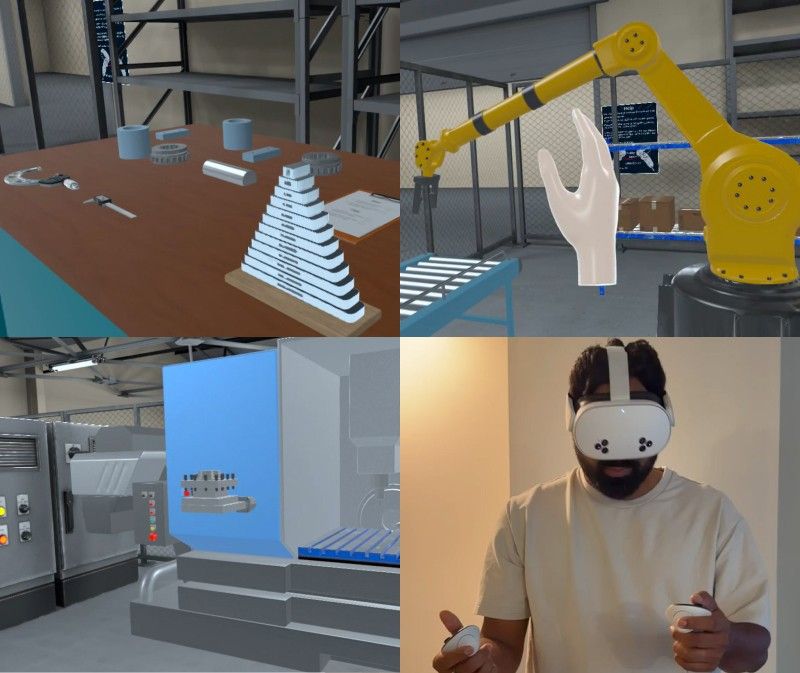
The ImmerseLearn Manufacturing Associate program is one of our online, hands-on, self-paced, IACET-accredited VR certification programs. It takes about 15 weeks and includes more than 120 hours of hands-on VR manufacturing training, with a VR headset included. No prior manufacturing experience is required.

In VR you practice real plant tasks, including:
- 1. Spotting hazards on a manufacturing workplace walkthrough
- 2. Measuring parts with vernier and digital calipers
- 3. Finding defects during quality inspection
- 4. Operating a robotic arm safely
- 5. Organizing a work area with 5S
Students earn the SME Certified Manufacturing Associate (CMfgA) credential after passing the SME certification exam. Across our programs, students see an 82% completion rate and an 87% job placement rate.
Career services and job placement after you graduate
ImmerseLearn offers job placement support through Career Services. Support includes:
- 1. One on one career and job readiness coaching
- 2. Resume help and interview practice
- 3. Job search guidance and connections through our employer partner network
Program cost
The Manufacturing Associate program offers these payment plans:
- 1. VR Program, with a VR headset shipped at enrollment: $3,800 on a 6-month plan, $4,200 on a 12-month plan or $4,400 on a 15-month plan. Each plan starts with $650 at enrollment.
- 2. Non-VR program, web-based without a VR headset: $2,000 on a 6-month plan or $2,200 on a 9-month plan. Each plan starts with $200 at enrollment.
Bi-weekly payments follow the down payment.
FAQs
Do I need experience to become a manufacturing associate?
No. Many employers hire entry level associates, and the ImmerseLearn Manufacturing Associate program requires no prior manufacturing experience.
How long does manufacturing associate training take?
Program length varies. The ImmerseLearn Manufacturing Associate program takes about 15 weeks and includes more than 120 hours of hands-on VR training.
What is the SME CMfgA?
The Certified Manufacturing Associate (CMfgA) is an entry level credential from SME that covers basic manufacturing concepts such as shop math, assembly, maintenance, machining, inspection and safety. You earn it by passing the SME certification exam.
What jobs can a manufacturing associate get?
Common roles include production associate, assembly technician, machine operator, production operator, quality inspector, material handler and CNC machine operator.
How much does a manufacturing associate make?
Based on BLS production occupations data, typical pay ranges from about $30,000 to $70,000 or more, depending on the role, employer, location and experience.
See the full schedule, exam details and payment options on the Manufacturing Associate program page, then talk with enrollment before you commit.