

Top Solar Technician Skills: Complete Career Guide
Introduction:
Solar technicians need expertise in solar PV installation, electrical wiring, inverter configuration, Battery Energy Storage Systems (BESS), troubleshooting, safety compliance, and smart monitoring. Among these, troubleshooting and battery technologies are some of the fastest growing areas in the renewable power industry.
As projects expand across residential, commercial, and utility scale sectors, employers increasingly seek technicians who can work with PV systems, electrical infrastructure, inverters, battery solutions, and performance monitoring technologies.
Whether we are ITI students, electricians, vocational learners, or aspiring renewable power professionals, developing these capabilities can help us become job ready and succeed in the modern workforce.
This guide covers the most important solar technician skills, why employers value them, and how they are applied in real world projects.
Key Takeaways
- Discover the most in demand solar technician skills employers look for in today's renewable energy industry.
- Explore advanced skills such as Battery Energy Storage Systems (BESS), SCADA monitoring, and EV charging integration.
- Understand the safety practices, tools, and technical knowledge required for long term success in solar careers.
- Structured training and practical experience help technicians become job ready faster.
- The solar industry continues to experience strong workforce demand and long term career growth.
Why Solar Technician Skills Are in High Demand
Solar technician skills are more important than ever as modern renewable power systems become increasingly advanced. Employers seek technicians who can install, maintain, and troubleshoot complete power generation systems.
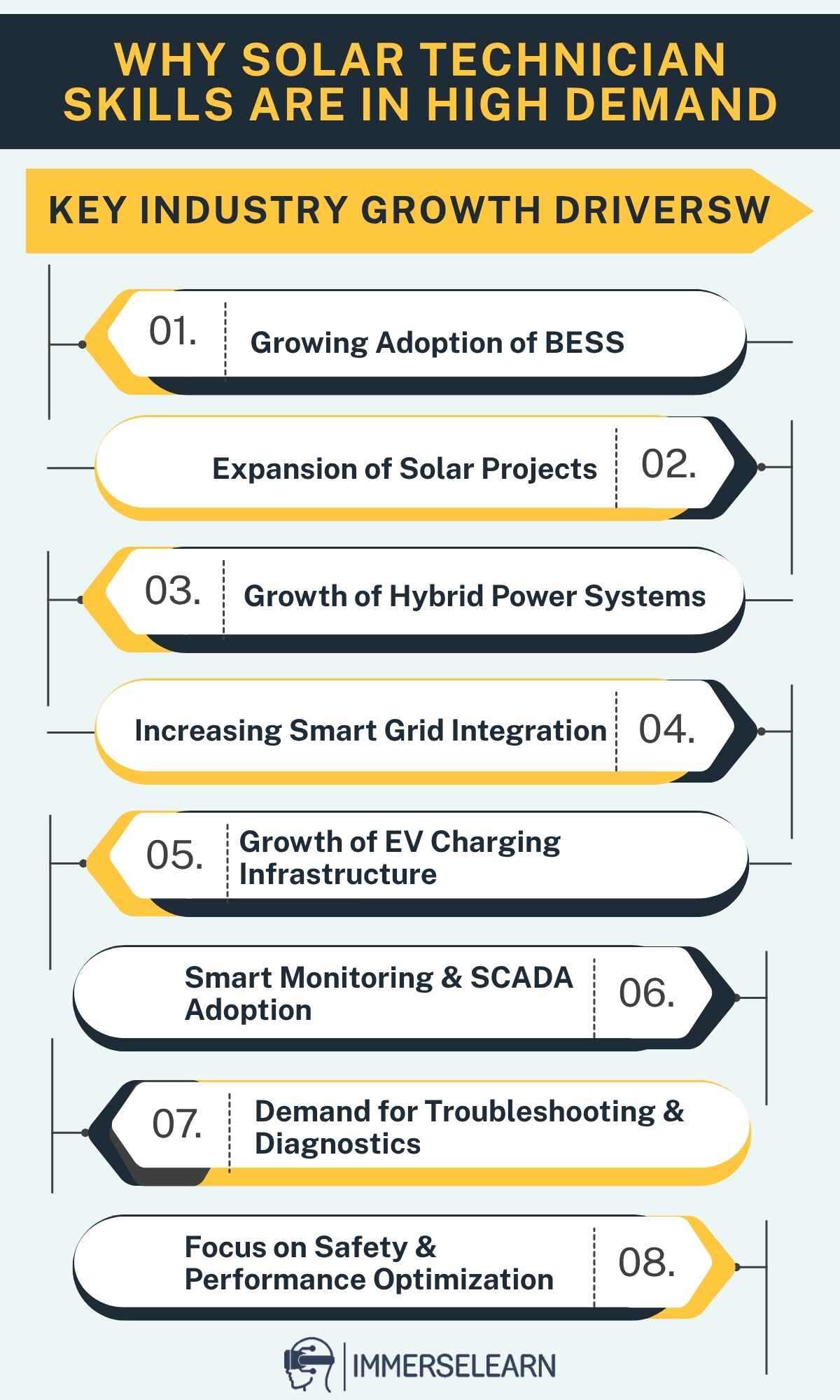
Key Factors Driving Industry Growth:
- Growing adoption of Battery Energy Storage Systems (BESS)
- Expansion of rooftop PV installations and utility scale projects
- Increasing use of hybrid power systems
- Rising demand for smart grid integration
- Growth of EV charging infrastructure
- Greater reliance on smart monitoring and SCADA platforms
- Higher demand for troubleshooting and system diagnostics
- Strong focus on safety compliance and performance optimization
As clean technology continues to evolve, technicians with expertise in solar PV installation, electrical systems, and troubleshooting are becoming highly valuable across the renewable power industry.
The U.S. Bureau of Labor Statistics (BLS) projects 42% job growth for solar photovoltaic installers from 2024 to 2034, indicating strong industry demand.
Read more: Certified Solar Technician Career Guide
Top Skills Employers Expect from Solar Technicians
Real job descriptions from EPC contractors, O&M companies, and rooftop solar installers reveal a clear priority for solar technician skills. Employers value practical, job ready skills that support real world solar projects. Below is a breakdown based on employer demand:
| Skill | Employer Demand | Level |
| Solar PV Installation | Very High | Beginner |
| Electrical Wiring (AC/DC) | Very High | Beginner |
| Inverter Setup & Configuration | Very High | Beginner |
| System Troubleshooting | High | Intermediate |
| Battery Storage (BESS) Setup | High | Intermediate |
| Safety Compliance (PPE, LOTO) | Very High | Beginner |
| Site Inspection & Assessment | Medium | Intermediate |
| Smart Monitoring / SCADA | Growing | Advanced |
| Technical Drawing / Schematics | Medium | Intermediate |
| EV Charging Integration | Emerging | Advance |
What Makes a Candidate Stand Out:
Technicians with skills in troubleshooting, Battery Energy Storage Systems (BESS), performance analysis, and system optimization are highly valued by employers because they help improve system performance, reduce downtime, and maximize energy output.
Essential Solar Technician Skills by Category
To become job ready in the solar energy industry, we need to build solar technician skills progressively, from core technical skills to advanced competencies. These skills can be grouped into four key categories:
| Core Technical | Advanced Technical | Safety Skills | Soft Skills |
| Solar PV Installation | BESS / Battery Storage | PPE Usage | Problem-Solving |
| Electrical Wiring (AC/DC) | Hybrid Inverters | Lockout/Tagout (LOTO) | Communication |
| Inverter Setup | SCADA Monitoring | Rooftop Fall Protection | Time Management |
| Basic Troubleshooting | MPPT Configuration | Electrical Hazard Control | Technical Documentation |
| Net Metering Basics | Microinverter Setup | Emergency Response | Client Interaction |
| String Array Configuration | Grid Integration | NEC Compliance Basics | Teamwork |
Core Solar Technician Skills
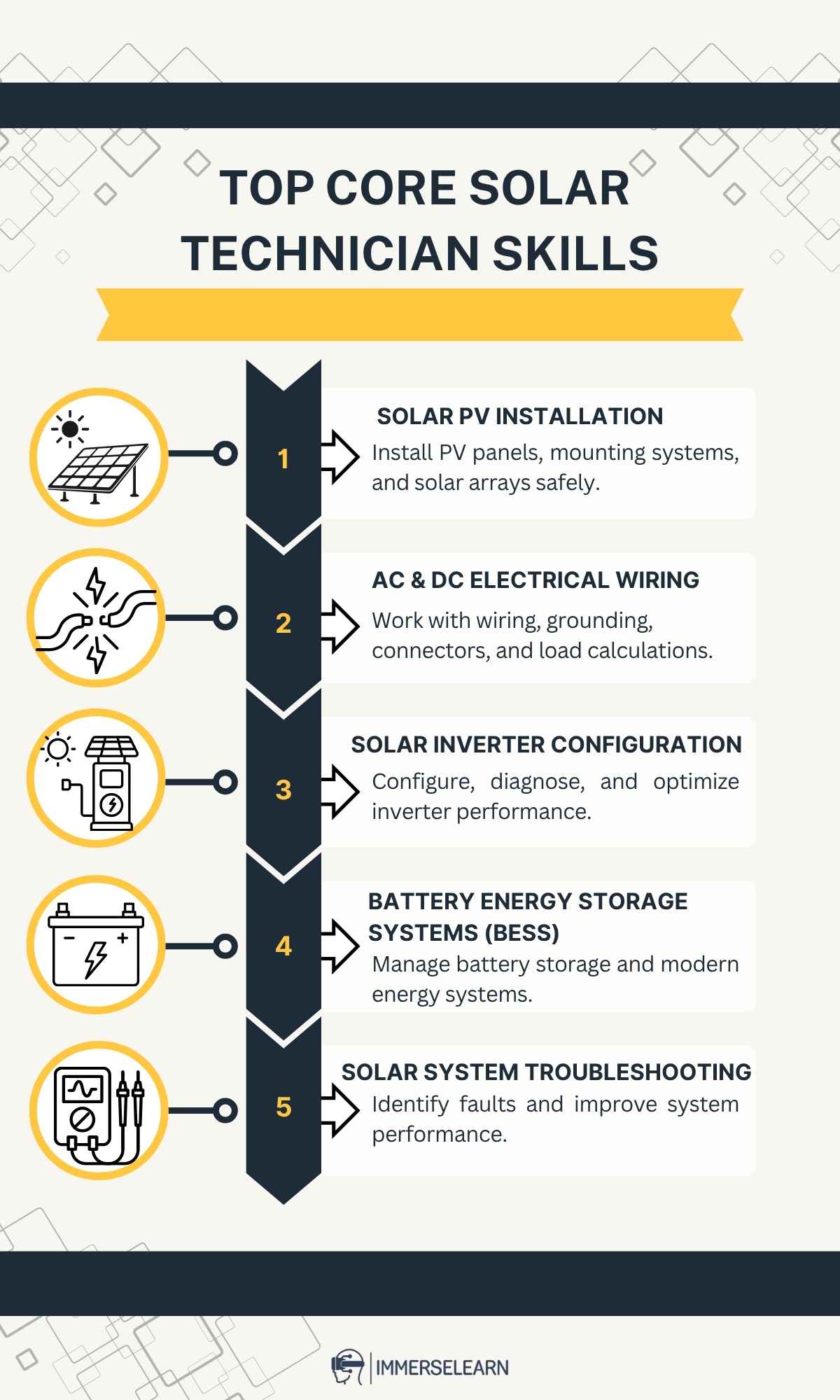
1) Solar PV Installation Skills
Solar PV installation is a fundamental solar technician skill. Photovoltaic arrays generate electricity through semiconductor based cells connected into modules and strings used in rooftop and utility scale projects.
Technicians must know how to install PV panels, racking structures, and photovoltaic (PV) arrays for safe and efficient power generation.
The three main installation types are:
- Grid tied systems: Common in residential and commercial installations
- Off grid systems: Used in areas without grid access
- Hybrid systems: Combine PV generation, battery storage, and grid connectivity
2) AC and DC Electrical Wiring Basics
Electrical wiring is a core solar technician skill because PV installations operate with DC power from panels and AC power after inverter conversion. Key areas include cable sizing, MC4 connector crimping, grounding and bonding, over current protection, and load calculations.
Many employers prefer candidates with an ITI Electrician or Wireman background, as strong electrical fundamentals support safe and efficient PV installations.
3) Solar Inverter Setup and Configuration
Inverter configuration is a key solar technician skill. Inverters convert DC power from PV panels into AC power for homes, businesses, and the grid.
Common Types of Solar Inverters:
- String inverters: Common in residential and commercial installations
- Microinverters: Used for module level optimization
- Hybrid inverters: Combine PV generation with battery storage
Technicians should also be able to read error codes, perform diagnostics, update firmware, and configure MPPT (Maximum Power Point Tracking) settings.
4) Battery Energy Storage Systems (BESS)
Battery Energy Storage Systems (BESS) are among the most in demand solar technician skills in the solar energy industry. According to the Deloitte Renewable Energy Industry Outlook, battery storage is a leading investment area in clean energy. BESS expertise helps distinguish entry level technicians from advanced professionals working with modern energy storage systems.
5) Solar System Troubleshooting Techniques
Troubleshooting is a critical solar technician skill that helps identify and resolve issues affecting power generation, including reduced output, shading losses, failed MPPT channels, loose MC4 connectors, and inverter faults.
Essential Diagnostic Tools and Methods:
- Multimeter voltage and continuity testing
- Clamp meter current measurement
- Thermal imaging for hotspot detection
- IV curve tracing for module level diagnostics
- Monitoring data analysis comparing actual and expected performance
Advanced Skills for Modern Solar Energy Systems
Advanced solar technician skills are increasingly important for working with modern renewable power technologies, smart monitoring solutions, and large scale clean energy projects.
1) SCADA and Smart Monitoring Systems:
Modern PV plants use SCADA (Supervisory Control and Data Acquisition) platforms and IoT based monitoring tools for real time performance tracking. Technicians should be able to interpret dashboards, configure alerts, and perform remote diagnostics to improve operational efficiency and reduce downtime.
2) Grid Integration and Net Metering Concepts:
Grid connected PV installations require knowledge of net metering, export limiting, anti islanding protection, interconnection standards, and local grid compliance requirements. These skills are essential for residential, commercial, and utility scale projects.
3) EV Charging System Integration:
EV charging integration is becoming a valuable solar technician skill. It involves installing and configuring DC fast charging infrastructure alongside solar PV installations and Battery Energy Storage Systems (BESS). Professionals with expertise in both renewable power and EV infrastructure are increasingly in demand.
Essential Safety Practices for Solar Technicians
Working at heights, handling live electrical equipment, and operating in high temperature environments make risk management a critical part of every technician's role. Strong knowledge of protective practices improves compliance, performance, and workplace protection.
Workplace Safety and Risk Management
- PPE selection and usage
- Lockout/Tagout (LOTO)
- Rooftop fall protection and harness systems
- DC arc flash awareness
- Heat stroke prevention
- NEC electrical compliance
- Emergency shutdown procedures
- Safe rooftop tool handling
Employers highly value proper risk prevention training because mistakes can lead to accidents, equipment downtime, and legal liabilities.
These safety practices are covered in the Photovoltaic System Safety Essentials micro-credential.
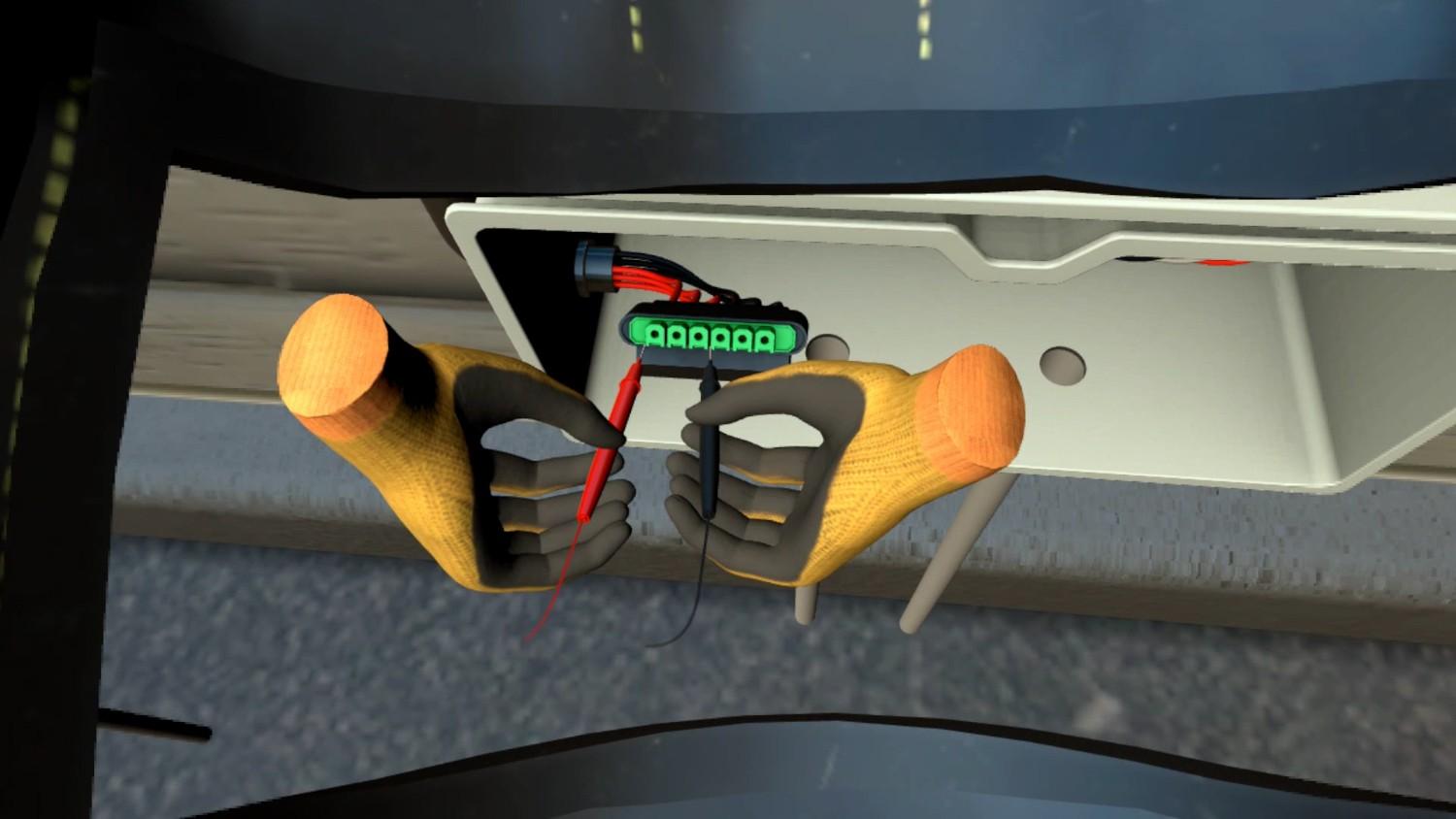
Real-World Solar Safety Example:
During a rooftop installation project, a technician avoided a potential electric shock by following Lockout/Tagout (LOTO) procedures before inverter maintenance. This prevented accidental DC backfeed from the photovoltaic array and ensured safe repair operations.
Soft Skills Required in the Solar Industry
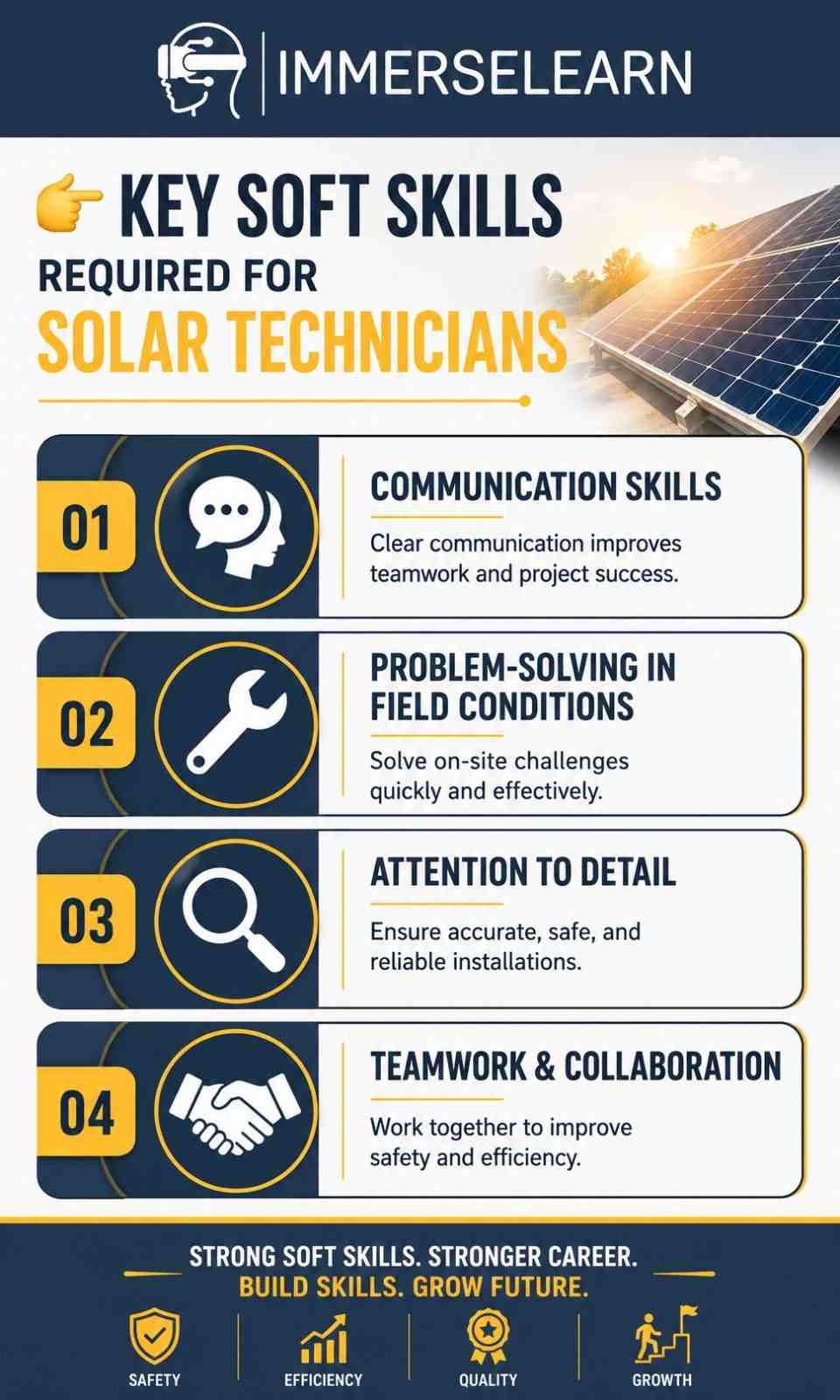
Solar technician soft skills are essential for career growth and workplace success. Employers value communication, problem solving, attention to detail, and teamwork alongside technical expertise.
1) Communication in Solar Projects:
As technicians, we interact with customers, supervisors, engineers, electricians, and project managers daily. Strong communication helps us:
- Clearly explain PV system information in simple terms
- Accurately report installation progress and technical faults
- Build trust and confidence with customers
- Reduce errors caused by miscommunication
Good communication improves project efficiency and is a key part of professional technical skills.
2) Problem-Solving in Field Conditions
Every installation site presents unique challenges, including roof design limitations, wiring issues, equipment failures, and environmental conditions.
Strong problem solving helps us identify practical solutions quickly and ensures smooth project execution. This skill is especially valuable in real world fieldwork where conditions vary from site to site.
3) Attention to Detail in Installations
In photovoltaic (PV) installation, even small mistakes can reduce performance or cause equipment failures. Attention to detail helps ensure:
- Accurate wiring and secure electrical connections
- Correct configuration and setup
- High quality installation work
- Better compliance with safety and performance standards
Detail oriented professionals are often trusted with advanced responsibilities and leadership roles.
4) Teamwork in Renewable Energy Projects
Renewable energy projects require coordination between installers, electricians, engineers, inspectors, and project managers. Strong teamwork improves productivity, safety, and timely project completion across residential, commercial, and utility scale developments.
Tools and Equipment Used by Solar Technicians
Strong solar technician skills require hands-on experience with the equipment used for PV system setup, testing, maintenance, and workplace protection.
i) Electrical testing equipment: Digital Multimeter, Clamp Meter, Insulation Resistance Tester, and Voltage Tester for fault diagnosis and electrical measurements.
ii) Installation equipment: Wire Strippers, MC4 Crimping Devices, Torque Wrenches, and Power Drills for safe panel mounting and wiring.
iii) Inspection and monitoring instruments: Thermal Cameras, Solar Irradiance Meters, and Performance Monitoring Software for system evaluation and performance tracking.
iv) Protective gear: Harness Systems, Helmets, Protective Gloves, and Safety Glasses for compliance and worker protection.
How to Build Solar Technician Skills: Step-by-Step Path
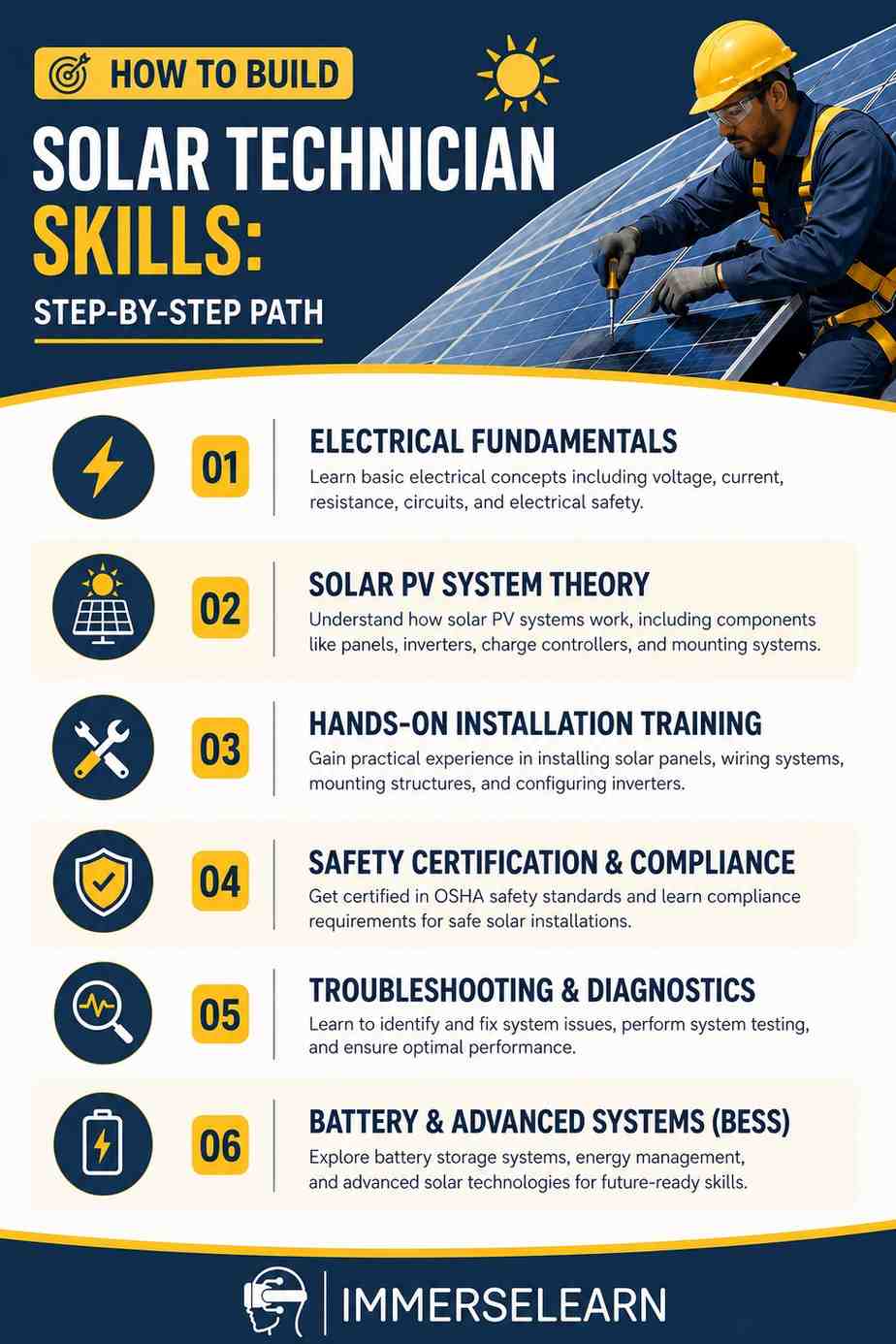
We can build solar technician skills through structured training, hands-on practice, and field experience. A typical learning path includes:
- Electrical Fundamentals: Learn DC/AC circuits, voltage, current, and protection devices through an ITI Electrician program or equivalent.
- Solar PV Theory: Understand photovoltaic cells, grid tied, off grid, and hybrid systems, plus key components such as panels, inverters, BMS, and meters.
- Hands On Installation Training: Gain practical experience with racking, wiring, MC4 connectors, and inverter commissioning. Many learners also follow ImmerseLearn’s PV Installer Training Course for guided hands-on installation and commissioning practice.
- Safety Certification: Learn rooftop safety, electrical safety, and first aid. Safety training is a key hiring requirement.
- Troubleshooting and Diagnostics: Use multimeters, clamp meters, and monitoring tools to identify and resolve system faults.
- Battery and Advanced Systems: Develop expertise in Battery Energy Storage Systems (BESS), hybrid inverters, and MPPT optimization.
Timeline: Most entry level technicians reach Step 4 within 6 to 12 months. Reaching advanced BESS and diagnostic skills typically takes 2 to 3 years of training and field experience.
How VR Training Enhances Solar Skill Development
Practical Learning Without Real-World Risk
Building strong solar technician capabilities requires hands-on experience, but traditional learning programs often limit practical exposure because real photovoltaic systems are expensive and errors can create safety risks.
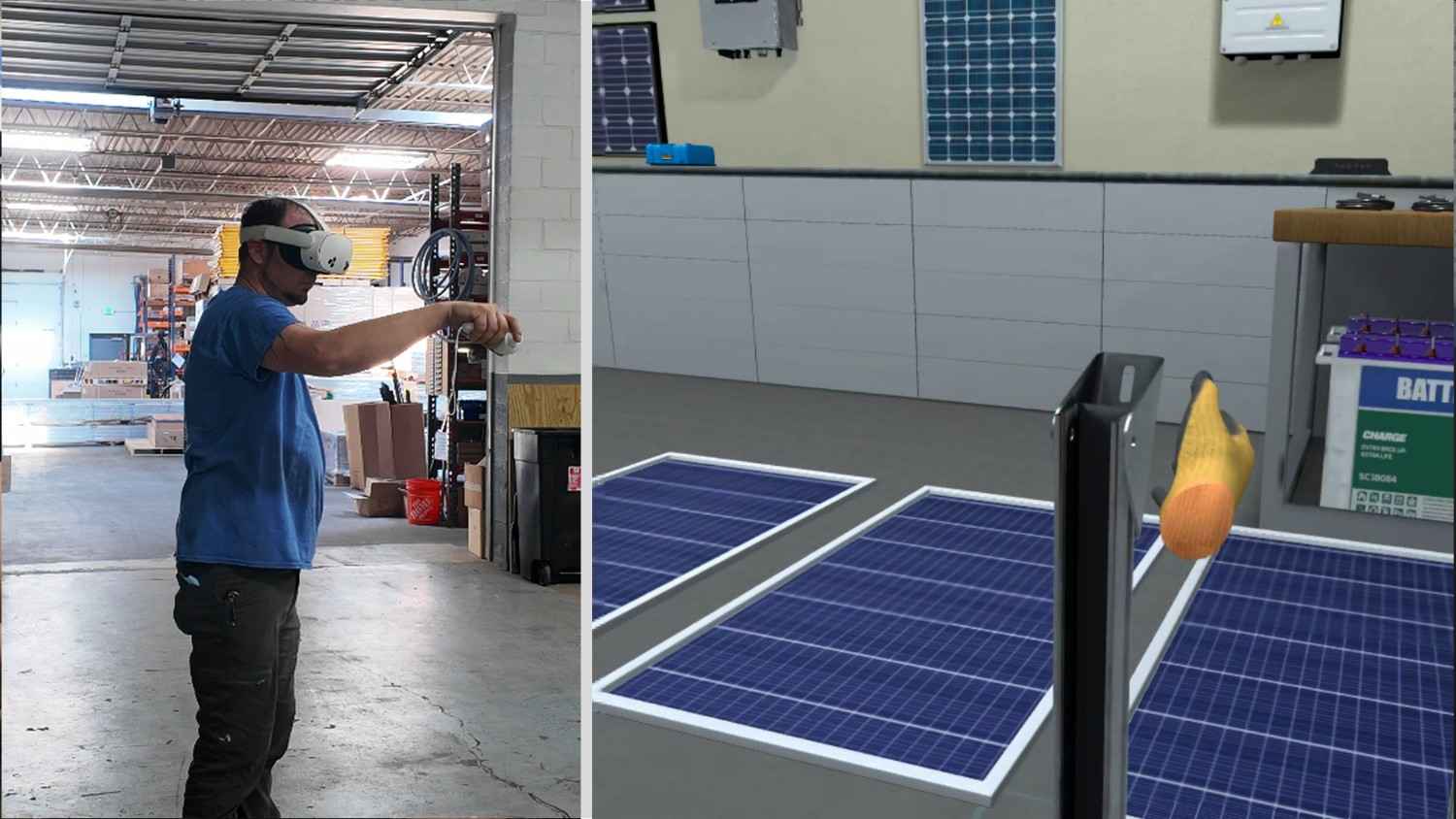
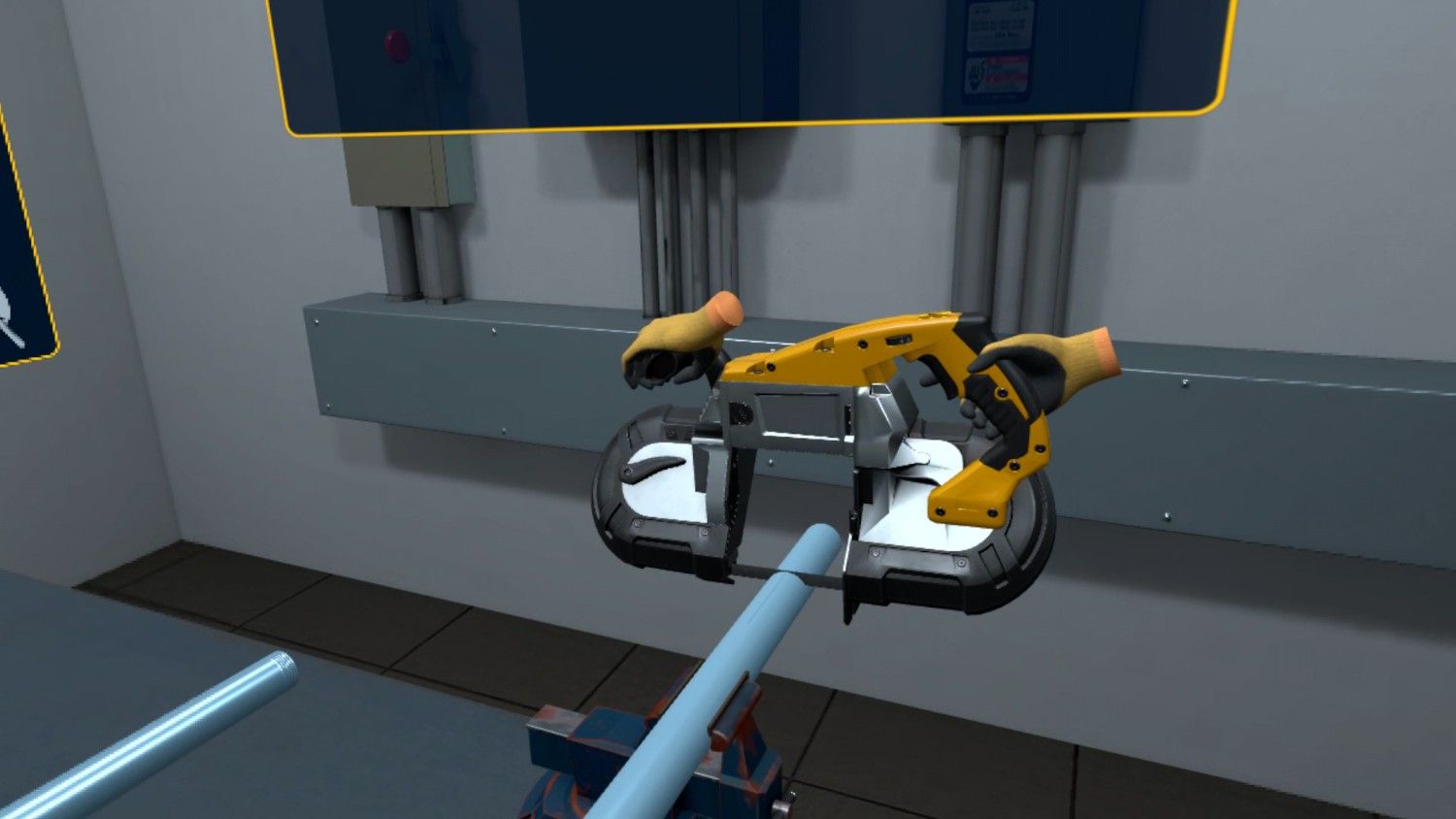
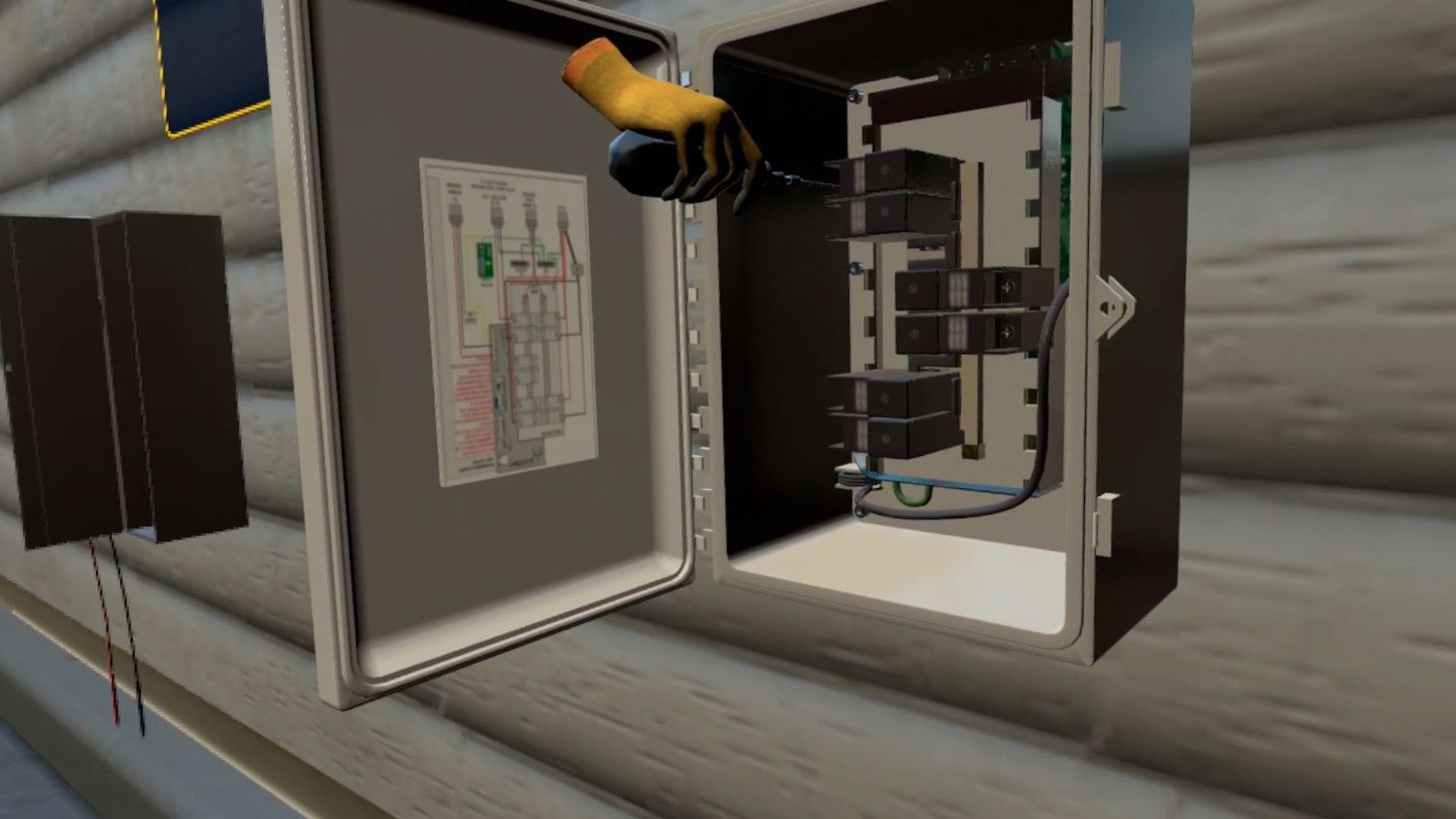
With VR based solar training, we can safely practice installation, troubleshooting, and maintenance in realistic environments. This helps us gain practical experience faster while building confidence through repeated practice.
Skills Gained Through VR-Based Training:
- PV fault diagnosis
- Battery wiring and connection practices
- Inverter commissioning
- Rooftop safety drills
- Lockout/Tagout (LOTO) procedures
- Solar monitoring system setup
By simulating real job site conditions, VR based learning strengthens troubleshooting ability, fault recognition, and hands on technical capability, helping learners become job ready faster for the modern renewable energy industry.
Future Skills for Solar Technicians in the Next Decade
The solar energy industry is evolving rapidly, and future solar technician skills will extend beyond installation and maintenance. As projects increasingly adopt Battery Energy Storage Systems (BESS), smart grids, EV charging infrastructure, and digital monitoring platforms, technicians will need expertise in Battery Management Systems (BMS), lithium ion batteries, storage integration, fault detection, grid level coordination, and distributed energy resources.
The expansion of EV charging networks and AI powered clean power solutions is also increasing demand for advanced system coordination, load management, power optimization, predictive maintenance, digital diagnostics, and remote troubleshooting. As a result, professionals in this field will focus more on managing and optimizing intelligent renewable power infrastructures.
Frequently Asked Questions
Q1) What is the most important capability for a solar technician?
Solar PV installation and electrical wiring are generally considered the most important foundational competencies because nearly every project depends on them. However, troubleshooting becomes the most valuable expertise as technicians gain experience.
Q2) How long does it take to learn solar technician competencies?
The timeline depends on the learning path. Basic installation and safety knowledge can often be developed within a few months, while advanced troubleshooting and battery storage expertise typically require ongoing hands-on field experience.
Q3) Do solar technicians need electrical knowledge?
Yes. Solar systems involve electrical circuits, inverters, disconnect switches, grounding systems, and power distribution equipment.
Q4) What skills increase a solar technician's value to employers?
Employers often value technicians who can:
- Troubleshoot complex issues
- Work with battery storage systems
- Commission inverters
- Interpret technical drawings
- Use monitoring platforms
- Follow strict safety procedures
Q5) Can someone become a solar technician without previous experience?
Yes. Many professionals enter the industry through vocational training, apprenticeships, technical programs, internships, and simulation-based learning environments.
To understand the entry pathway and training structure, you can explore the Solar Training Program.
Q6) What advanced skills should solar technicians learn next?
After mastering installation and electrical fundamentals, technicians should consider learning:
- Battery storage systems
- Smart inverters
- SCADA monitoring
- Hybrid systems
- EV charging integration
- Remote diagnostics
These skills align with the future direction of the industry.
Conclusion:
The renewable energy industry is evolving rapidly with PV systems, Battery Energy Storage Systems (BESS), smart grids, EV charging infrastructure, and intelligent monitoring platforms. As a result, modern solar technician skills now extend beyond installation into system management, troubleshooting, performance tracking, and optimization.
To succeed in this growing field, we should master core skills such as solar PV installation, electrical wiring, inverter configuration, system troubleshooting, and safety compliance, while building expertise in SCADA monitoring, battery storage systems, smart grid integration, and EV charging technologies. As renewable energy adoption continues to grow, technicians who continuously upgrade their technical skills will be better positioned for long term career growth and higher paying opportunities.
Which skill do you think is most important for becoming a high paying solar technician today?