
Compounding Creams & Ointments


Credits : 0.3
About the Course:
The Compounding Creams & Ointments Simulation microcredential equips pharmacy technician students with the essential knowledge and hands-on skills required to accurately prepare compounded topical creams and ointments using proper non-sterile compounding techniques and pharmacy safety standards.
Learners will practice precision weighing, levigation, geometric dilution, ingredient preparation, ointment blending, and final product packaging while maintaining procedural accuracy and contamination prevention throughout the compounding workflow.
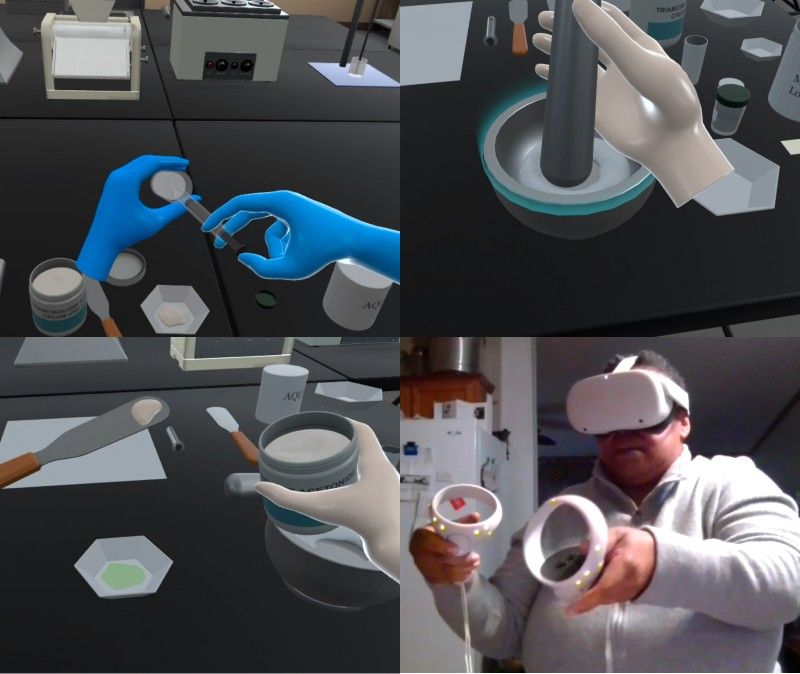
Through immersive VR simulations, students will engage in step-by-step compounding procedures including triturating Urea powder, measuring cream and Aquaphilic Ointment bases, withdrawing glycerine with syringes, preparing a smooth levigated paste, performing geometric dilution, and packaging the final compounded preparation into an ointment jar. The simulation reinforces precision, consistency, safety, and quality assurance at every stage of the process.
To further develop pharmacy compounding and medication preparation skills through interactive pharmacy technician learning, explore the ImmerseLearn Pharmacy Technician Program.
Learning Objectives:
- Explain the purpose and importance of compounding creams and ointments in pharmacy practice.
- Demonstrate proper weighing, measuring, and transferring of ingredients using balances, syringes, spatulas, and containers.
- Apply safe handling techniques while preparing powders, creams, and ointment bases.
- Perform levigation and trituration techniques to achieve smooth and uniform preparations.
- Demonstrate proper geometric dilution methods for combining compounded ingredients evenly.
- Safely transfer and package the final compounded product into dispensing containers.
- Follow quality assurance, labeling, documentation, and contamination prevention procedures during compounding.
Want to learn more about pharmaceutical compounding? Explore our complete guide to pharmacy compounding to understand non sterile compounding techniques, pharmacy safety standards, and ingredient preparation best practices.
Course delivered through our LMS and accessible in both VR and web. Learn on the web anytime, or enjoy immersive VR training with your own Oculus VR headset.
Workforce Development

At ImmerseLearn, we empower pharmacy technician students to build precision, consistency, and confidence in pharmaceutical compounding procedures. This microcredential strengthens technical accuracy, attention to detail, safe material handling, procedural compliance, and workflow organization essential skills required in modern pharmacy compounding environments.
By completing this microcredential, pharmacy technician students will gain the technical precision, procedural confidence, and compounding proficiency required to safely prepare creams and ointments while ensuring product consistency, patient safety, and adherence to professional pharmacy standards.
Explore our pharmacy technician online training course to further develop hands-on pharmacy skills and career readiness.