

Top Pharmacy Technician Skills Employers Look for Today
Introduction:
If you are exploring a pharmacy technician career, you may wonder which pharmacy technician skills employers value most.
Employers look beyond certification. They want candidates who can process prescriptions accurately, prevent medication errors, communicate with patients, use pharmacy software, and work with pharmacists and healthcare teams.
According to the U.S. Bureau of Labor Statistics, pharmacy technician employment is projected to grow 6% from 2024 to 2034. As demand grows, employers value job ready technical skills, soft skills, and real pharmacy workflow experience.
In this guide, we will cover:
- The top pharmacy technician skills employers value most
- Why these skills matter in real pharmacy settings
- How technical skills and soft skills work together
- Practical ways to build these skills before your first job
- Advanced skills that can help you grow your pharmacy career
By the end, you will understand which pharmacy technician skills matter most and how to start building them for real pharmacy roles.
What Are Pharmacy Technician Skills?
1. What Pharmacy Technician Skills Mean:
Pharmacy technician skills are the technical abilities, workplace competencies, and professional behaviors needed for medication preparation, prescription processing, pharmacy operations, and patient interactions. These skills help technicians maintain regulatory compliance, reduce medication errors, and support patient safety.
2. Technical Skills vs. Soft Skills:
Pharmacy technician skills include both technical skills and soft skills.
| Technical Skills | Soft Skills |
| Prescription Processing | Communication |
| Pharmacy Calculations | Attention to Detail |
| EHR and Pharmacy Software | Teamwork |
| Inventory Management | Customer Service |
| Insurance Claims Processing | Time Management |
| HIPAA and Regulatory Compliance | Problem-Solving |
| Medication Dispensing and Labeling | Adaptability |
Technical skills support essential pharmacy duties, while soft skills improve patient care, teamwork, and communication. Employers value both because pharmacy success depends on accuracy, collaboration, and confidence in real pharmacy workflows.
3. Why These Skills Help You Get Hired:
Many candidates assume certification alone is enough to secure a pharmacy technician position. While certification can strengthen a resume, employers also look closely at practical pharmacy skills.
Hiring managers want to know:
- Can the candidate process prescriptions accurately?
- Can they communicate professionally with patients?
- Can they work efficiently during busy periods?
- Do they understand medication safety principles?
- Can they adapt to pharmacy technology and workflow systems?
Candidates with both technical competency and workplace readiness are more competitive than those with theoretical knowledge alone.
Build job-ready pharmacy skills with online pharmacy technician training designed for real pharmacy workflows
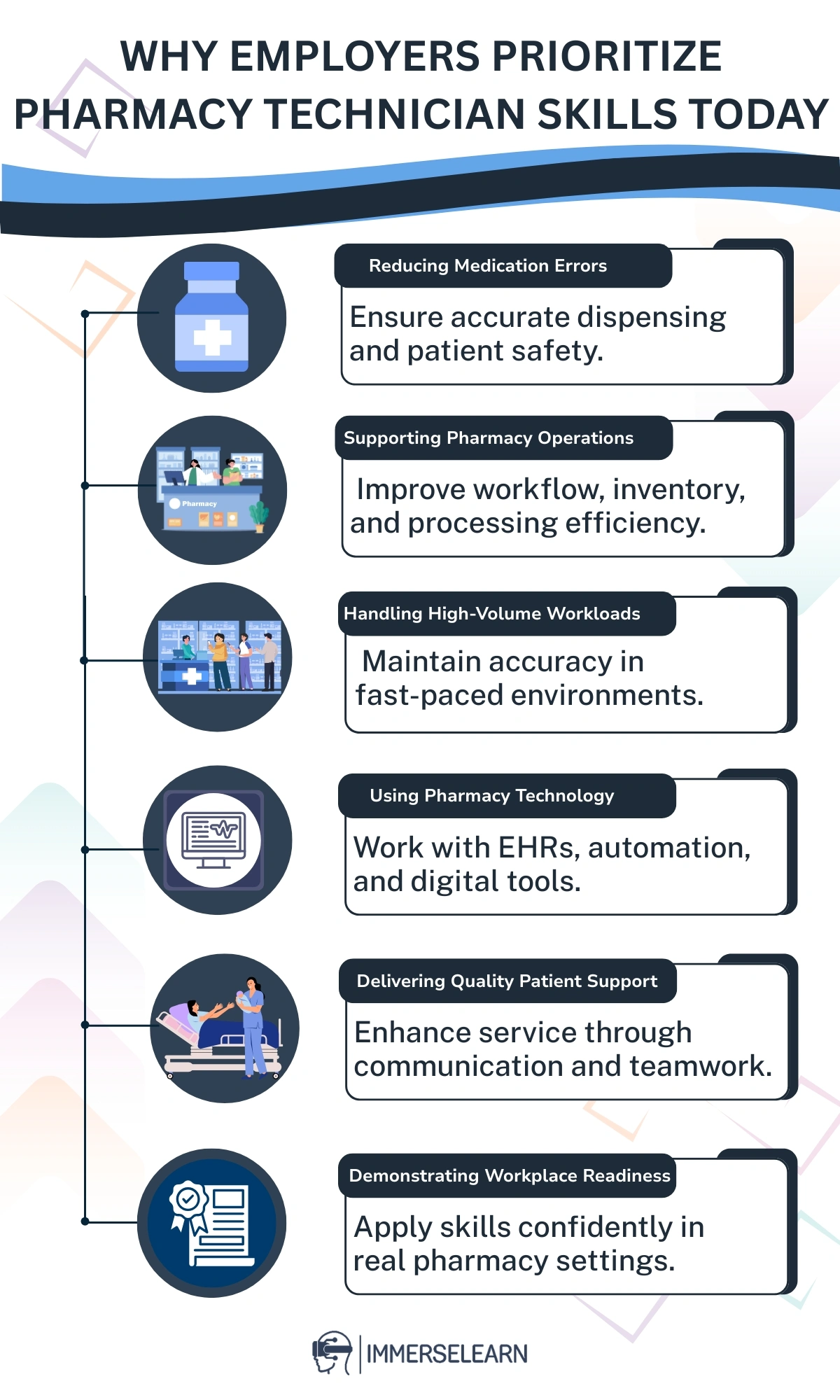
Why Pharmacy Technician Skills Matter to Employers
Employers prioritize pharmacy technician skills because technicians support medication safety, pharmacy efficiency, patient care, error prevention, and smoother pharmacy workflow in real pharmacy settings.
Key Reasons Employers Value These Skills:
- Reducing Medication Errors: Accurate prescription processing, pharmacy calculations, medication dispensing, and labeling help protect patient safety.
- Supporting Pharmacy Operations: Strong technical abilities improve workflow, inventory management, insurance processing, and routine operations.
- Handling High-Volume Workloads: Technicians must maintain accuracy, compliance, and focus in busy care environments.
- Using Pharmacy Technology: Modern pharmacies rely on pharmacy management software, EHR systems, automation tools, and digital workflows.
- Delivering Quality Patient Support: Communication, teamwork, and customer service help improve patient experience and pharmacy collaboration.
- Demonstrating Workplace Readiness: An NHA CPhT / ExCPT credential can validate foundational knowledge, but hiring teams also want candidates who can apply practical abilities in real settings.
Key Takeaway: Certification can help candidates get noticed, but practical job ready abilities are what hiring teams value most.
Core Technical Skills for Pharmacy Technicians
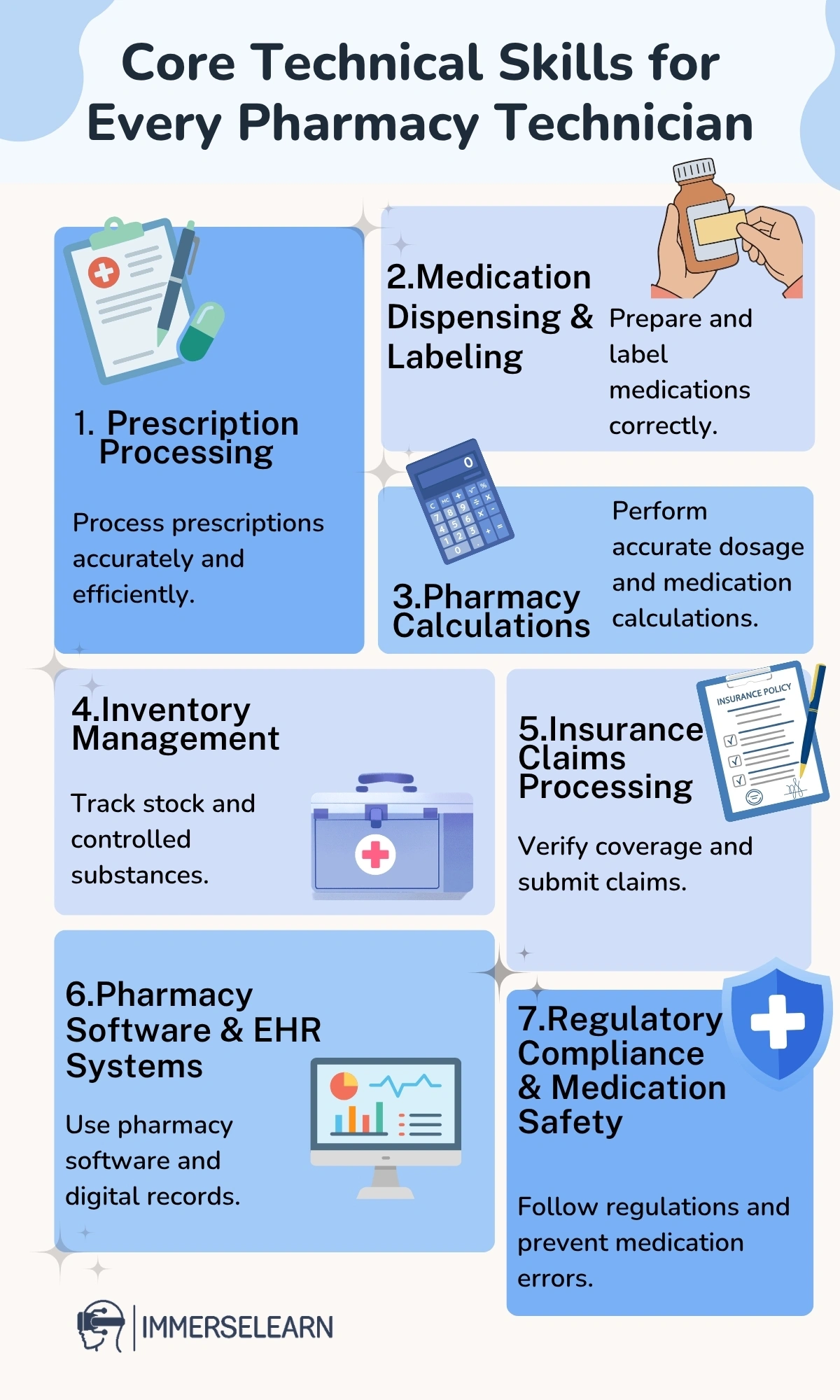
Strong pharmacy technician skills require technical accuracy in prescription processing, medication dispensing, pharmacy calculations, inventory management, insurance claims, pharmacy software, HIPAA compliance, and medication safety.
i) Prescription Processing
Prescription processing involves receiving prescriptions, verifying patient and prescriber information, entering data into the pharmacy system, identifying issues, and preparing medications for dispensing.
Accurate prescription processing supports pharmacy efficiency, reduces medication errors, and protects patient safety. Pharmacy technician training, externships, and hands on practice help build accuracy, confidence, and workflow familiarity.
Real World Example:
In a busy retail pharmacy, technicians may process dozens of prescriptions per hour by verifying patient information, checking insurance eligibility, entering medication details, and flagging issues for pharmacist review. Speed matters, but accuracy remains the top priority.
ii) Medication Dispensing and Labeling
Medication dispensing involves selecting, counting, preparing, and packaging medications based on a verified prescription. Accurate labeling includes patient information, dosage instructions, warnings, and medication details.
Because dispensing errors affect patient safety, employers value pharmacy technicians with accuracy, attention to detail, and strong compliance with pharmacy procedures.
iii) Pharmacy Calculations and Dosage Accuracy
Pharmacy calculations are essential for safe medication dispensing and dosage accuracy. Calculation errors can lead to incorrect dosages, making this one of the most important pharmacy technician skills.
Common Pharmacy Calculations :
i) Dosage conversions (milligrams to grams, milliliters to ounces)
ii) Days-supply calculations
iii) Compounding ratios and percentages
iv) Pediatric weight-based dosing
v) IV flow rate calculations
vi) Controlled substance inventory calculations
iii) Inventory Management and Controlled Substance Tracking
Pharmacy technicians manage medication inventory by receiving shipments, verifying quantities, monitoring stock levels, preventing expired medications, and tracking controlled substances with proper DEA documentation.
They should also understand product shortage and recall management to support compliance, medication availability, and patient safety.
iv) Insurance Verification and Claims Processing
Insurance-related tasks are common in many pharmacy settings.
Responsibilities may include:
- Verifying patient coverage
- Submitting claims
- Resolving claim rejections
- Communicating insurance information to patients
Technicians who understand insurance workflows can improve pharmacy efficiency, reduce prescription delays, and support a smoother patient experience.
v) Pharmacy Software and EHR Systems
Modern pharmacies use pharmacy management software and EHR systems to manage prescriptions, patient records, documentation, and workflow. Technicians who use these systems accurately improve productivity and patient safety.
Common Pharmacy Software Platforms:
- PioneerRx: used in independent retail pharmacies
- QS/1: used in retail, long-term care, and specialty pharmacies
- ScriptPro: used with automated dispensing systems
- Epic and Cerner: used in hospital and health system pharmacies
Employers value candidates who can learn pharmacy software quickly and use it accurately.
vi) Regulatory Compliance and HIPAA Awareness
Pharmacy technicians must follow HIPAA regulations, DEA requirements, state board of pharmacy rules, and pharmacy practice standards. The U.S. Department of Health and Human Services requires pharmacy personnel to protect patient health information under HIPAA privacy and security regulations.
For compounding roles, technicians should also understand compounding regulations and compliance, including USP standards, documentation, and quality assurance.
vii) Medication Safety and Error Prevention
Medication safety is a critical pharmacy technician skill. Technicians help prevent errors by verifying prescription information, checking medication details, following labeling procedures, and using safety protocols.
Employers value pharmacy technicians who demonstrate accuracy, attention to detail, and a strong commitment to patient safety.
Essential Soft Skills for Pharmacy Technicians
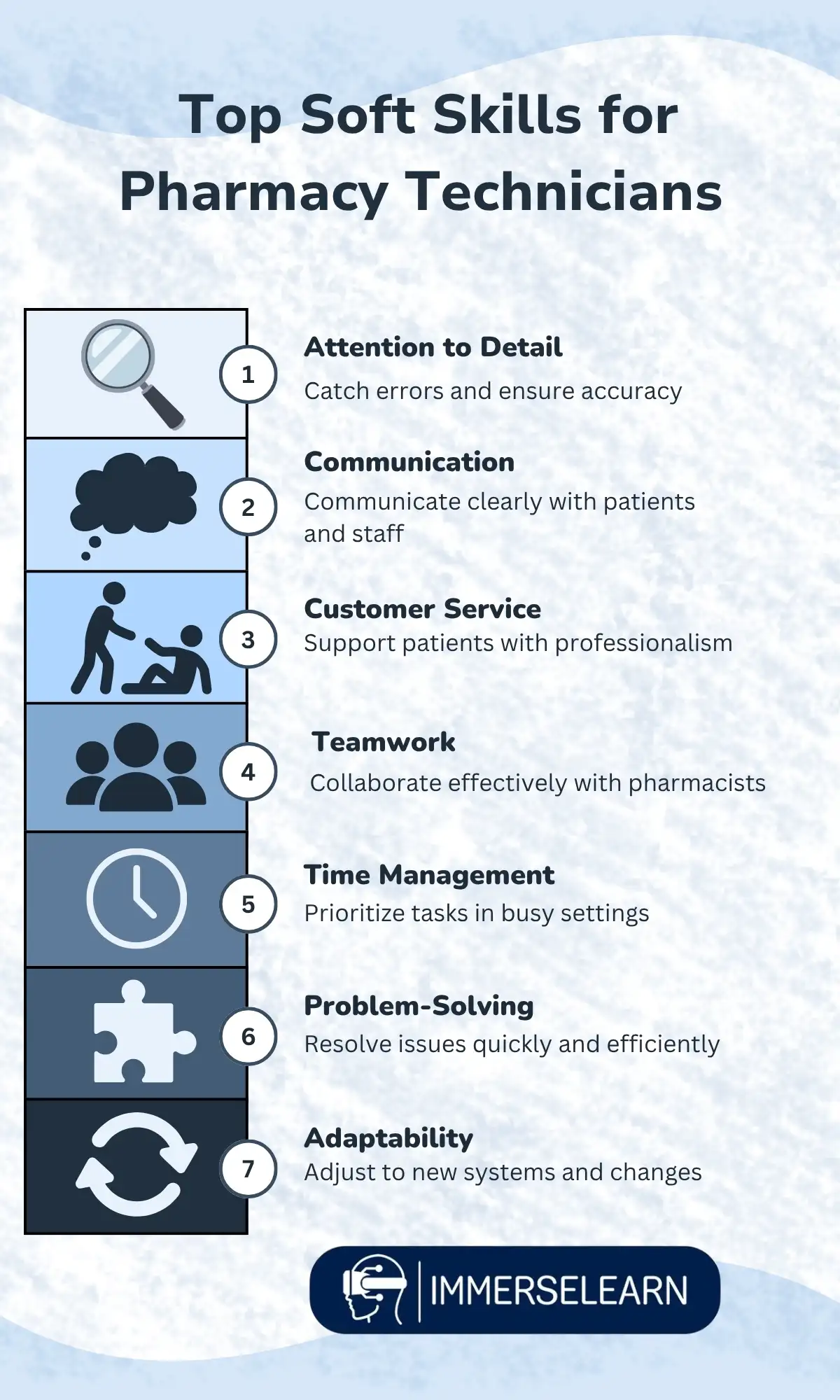
Soft skills are key pharmacy technician skills that support patient safety, accuracy, communication, and pharmacy workflow. They help technicians apply technical knowledge safely and professionally.
1) Attention to Detail
Pharmacy work requires strong accuracy. Small errors in drug names, dosages, instructions, data entry, or labeling can affect patient safety. Employers expect technicians to double check information, follow pharmacy procedures, and maintain accurate prescription records.
Real World Example:
A technician notices a dosage mismatch between the prescription and system entry and alerts the pharmacist before dispensing.
2) Communication Skills
Pharmacy technicians communicate with patients, pharmacists, prescribers, doctors, and insurance providers. Clear communication helps reduce misunderstandings, prevent medication errors, and improve patient care.
Real World Example:
A technician explains prescription pickup steps to a confused patient and confirms understanding.
3) Customer Service
Patients may be stressed, unwell, or confused about medications. Pharmacy technicians need patience, respect, and professionalism when answering questions and guiding patients through pharmacy services.
4) Teamwork and Pharmacist Collaboration
Pharmacy operations depend on teamwork between technicians and pharmacists. Strong collaboration supports safe prescription processing, faster workflow, and better patient outcomes.
Real World Example:
A technician identifies an insurance issue and works with the pharmacist to resolve it quickly, helping prevent delays in patient care.
5) Time Management
Busy pharmacies handle high prescription volumes. Strong time management helps technicians prioritize tasks, support pharmacy workflow, and maintain accuracy under pressure.
6) Problem Solving Skills
Common pharmacy issues include insurance rejections, missing prescriptions, stock shortages, and patient questions. Effective technicians identify problems, find solutions, and escalate concerns when pharmacist review is needed.
7) Adaptability
Pharmacy systems, tools, regulations, and workflows change often. Adaptable pharmacy technicians learn quickly, adjust to new procedures, and support smooth daily operations.
Essential and Advanced Pharmacy Technician Skills
Some pharmacy technician skills are required for entry level roles, while advanced skills help candidates qualify for hospital, specialty, or compounding pharmacy positions and support long term career growth.
1. Entry Level Skills Every Technician Needs
These are non-negotiable skills expected in almost all pharmacy settings:
- Prescription processing accuracy
- Basic pharmacy calculations
- Medication dispensing and labeling
- Customer service and patient communication
- Strong attention to detail
- Basic pharmacy software navigation
- HIPAA and regulatory compliance awareness
- Teamwork and pharmacist coordination
Practical Insight:
Certification can help candidates get interviews, but employers also look for practical pharmacy skills such as communication, accuracy, workflow awareness, medication safety, and pharmacy software proficiency.
2. Advanced Skills That Improve Employability
Advanced pharmacy technician skills can help candidates stand out and prepare for specialized roles.
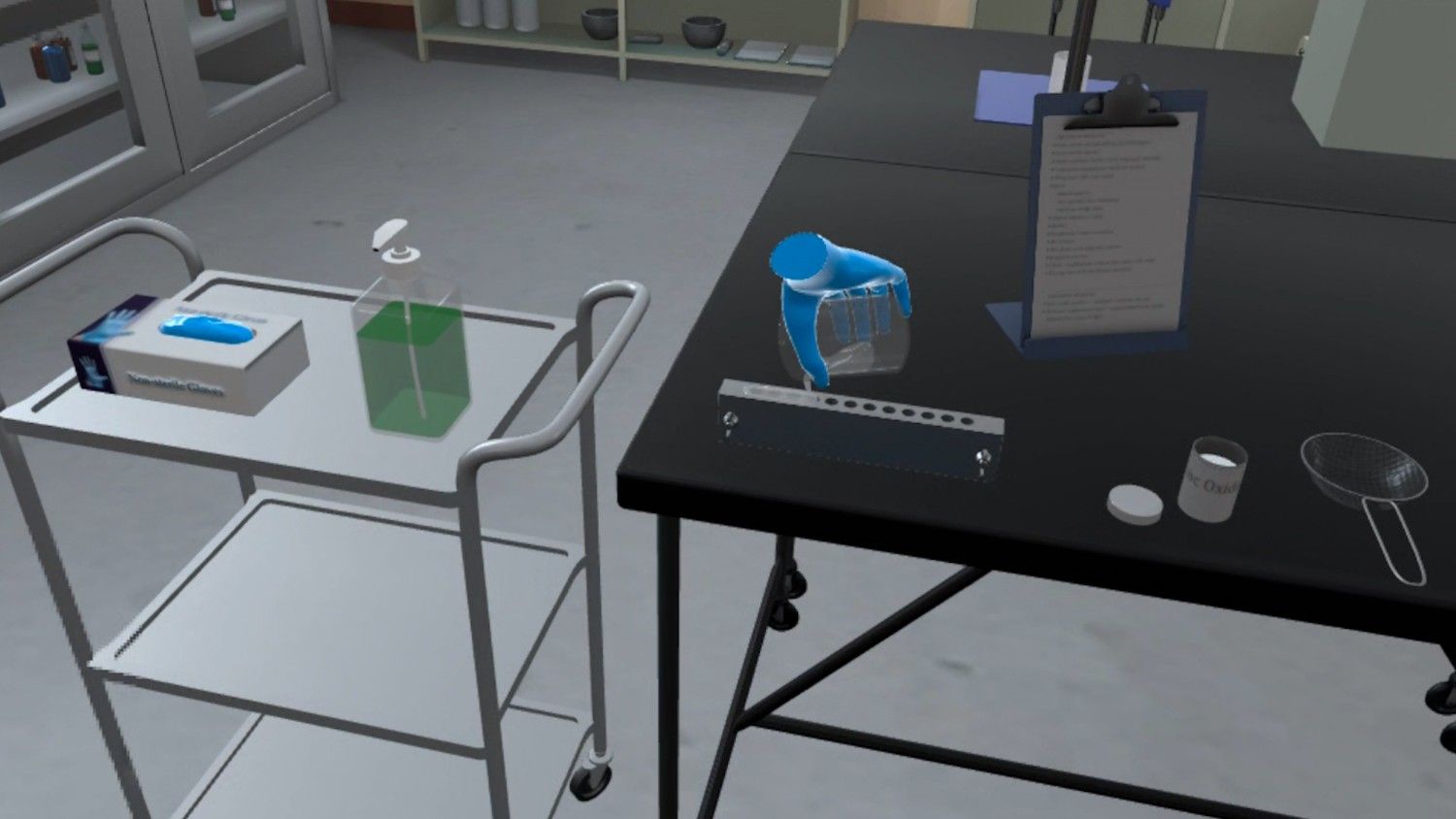
- Sterile Compounding: Preparing injections and IV medications in contamination free environments using strict aseptic techniques.
- Non-Sterile Compounding: Creating customized medications such as creams, ointments, and oral solutions with accurate measurements.
- IV Preparation: Safely preparing intravenous medications with correct dosing and sterile procedures.
- Specialty Pharmacy Knowledge: Handling complex medications, prior authorizations, and patient support workflows.
- Advanced EHR Systems: Proficiency in hospital-grade platforms like Epic or Cerner demonstrates readiness for clinical pharmacy environments.
3. Future Ready Pharmacy Skills
These skills are becoming increasingly important as pharmacy systems evolve:
- Pharmacy automation systems (dispensing machines, workflow automation)
- Digital pharmacy platforms (telepharmacy, e-prescribing systems)
- E-prescribing workflows (end-to-end prescription processing)
- Medication Therapy Management (MTM) support skills
| Essential Skills (Entry-Level Requirements) | Advanced Skills (Career Growth & Specialization) |
| Communication & patient interaction | Sterile compounding (IV preparations, aseptic techniques) |
| Accuracy in prescriptions and labeling | Pharmacy automation systems |
| Pharmacy calculations | Advanced EHR systems (Epic, Cerner) |
| Patient safety awareness | Specialty pharmacy knowledge |
| Basic pharmacy software usage | Non-sterile compounding & IV preparation workflows |
How Pharmacy Technician Skills Apply in Workflow
Workplace readiness comes from applying pharmacy technician skills across pharmacy workflows, from prescription processing to patient communication.
Step-by-Step Pharmacy Workflow:
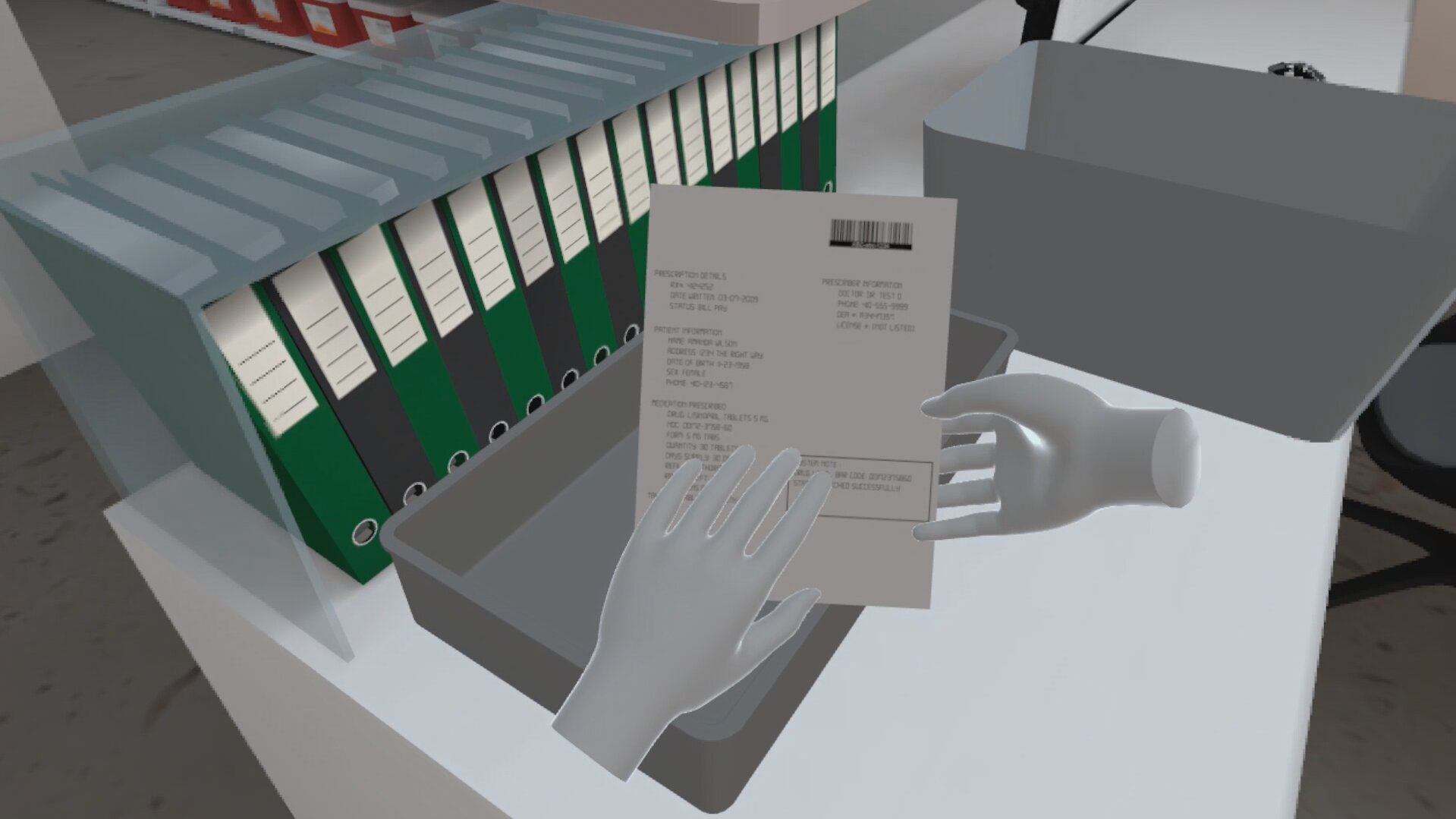
Step 1: Prescription Received
A prescription may arrive electronically, by phone, or on paper. The technician checks it for completeness, accuracy, patient information, and prescriber details.
Skills used: Attention to detail, regulatory awareness, communication
Step 2: Insurance Verification
The order is processed through insurance. If rejected, the technician helps resolve coverage issues, formulary problems, or missing information.
Skills used: Insurance processing, problem solving, communication
Step 3: Data Entry
Prescription details are entered into the pharmacy system, including patient information, drug name, dosage, quantity, directions, and refill details.
Skills used: Accuracy, attention to detail, pharmacy software
Step 4: Pharmacy Calculation
Dosage, days supply, quantity, or compounding measurements are calculated when required.
Skills used: Pharmacy calculations, dosage accuracy
Step 5: Medication Preparation
The medication is selected, counted, packaged, or prepared according to the verified prescription. In some settings, sterile compounding may also be performed.
Skills used: Medication dispensing, inventory management, sterile technique
Step 6: Pharmacist Verification
The pharmacist reviews the order before dispensing. The technician helps ensure all details, labels, documentation, and prepared medications are accurate.
Skills used: Teamwork, communication, documentation
Step 7: Patient Handoff
The medication is provided to the patient after identity confirmation. The technician may support pickup instructions, basic communication, and HIPAA compliant patient interaction.
Skills used: Customer service, communication, HIPAA compliance
Real-World Pharmacy Technician Scenario
Maria, a pharmacy technician, receives a blood pressure medication order, but insurance rejects it due to prior authorization.
She verifies the patient profile, contacts the prescriber, starts the authorization process, informs the patient, documents the issue, updates the pharmacist, then processes the claim and completes the patient handoff after approval.
This shows how pharmacy technician skills such as insurance processing, communication, documentation, teamwork, and time management work together in real practice.
Read more: How VR Training Prepares Pharmacy Technicians
Pharmacy Technician Skills by Workplace Setting
Pharmacy technician skills vary across retail, hospital, specialty, and long term care environments.
- Retail Setting: Customer service, insurance processing, prescription accuracy, cash handling, and POS system use
- Hospital Setting: Sterile compounding, EHR systems such as Epic and Cerner, clinical teamwork, and unit dose distribution
- Specialty Setting: Prior authorization support, patient coordination, complex drug handling, and disease specific treatment knowledge
- Long Term Care Setting: Dose packaging, blister packing, resident record management, accuracy, and workflow support
Explore our pharmacy settings and roles microcredential to understand technician duties across pharmacy environments.
How to Build Pharmacy Technician Skills
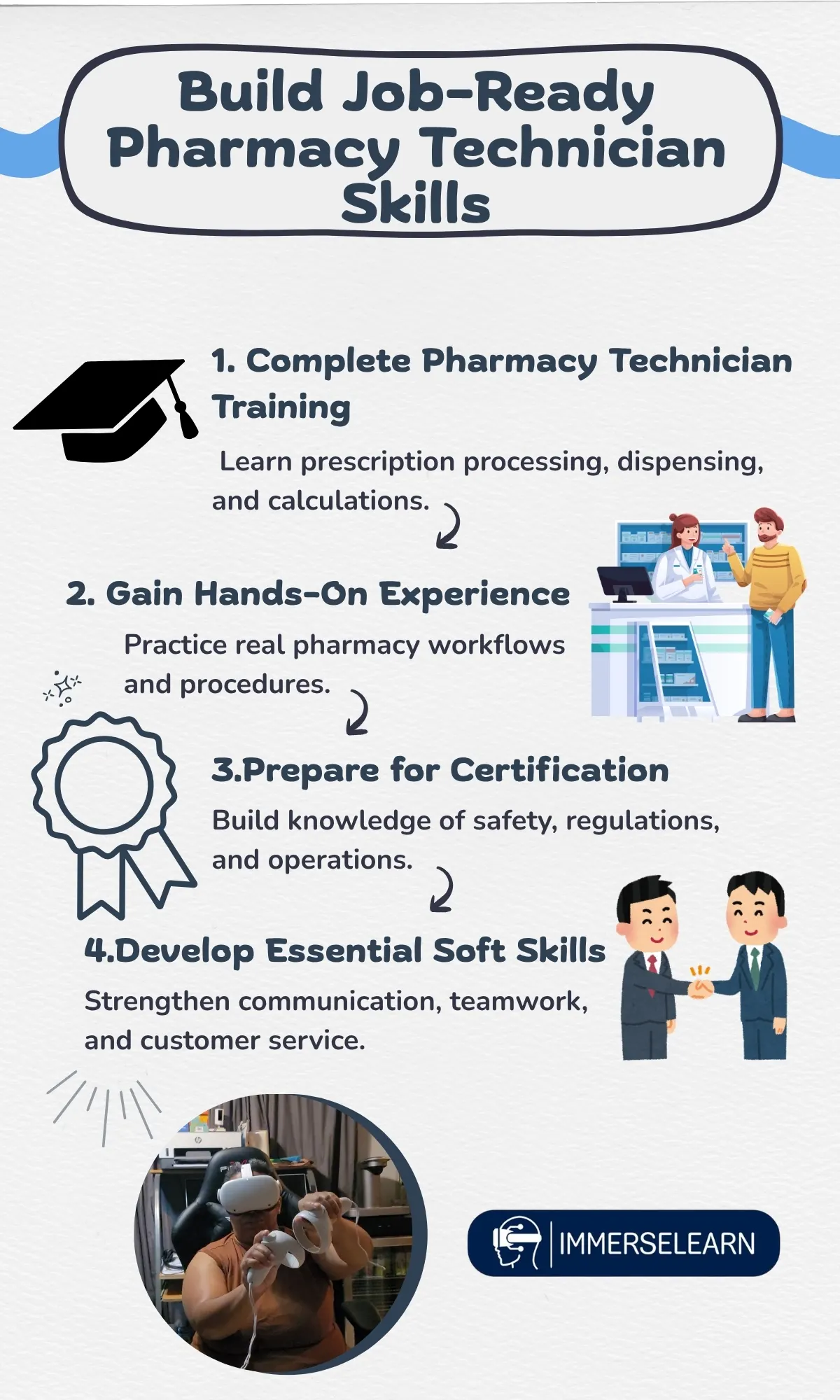
Strong career readiness starts with structured learning, hands-on practice, certification preparation, and soft skill development. These steps help learners gain confidence before entering real workplace responsibilities.
i) Complete Pharmacy Technician Training: A structured hands-on pharmacy technician training program helps students build prescription processing, medication dispensing, inventory management, pharmacy law, and patient safety skills.
ii) Gain Hands On Experience: Hands-on practice improves confidence, accuracy, and workflow understanding before entering the workplace.
iii) Prepare for Certification: Certification preparation strengthens medication safety, dosage calculations, regulations, daily operations, and job ready abilities.
iv) Develop Essential Soft Skills: Communication, attention to detail, teamwork, customer service, and time management support patient care, workplace success, and professional growth.
Common Skill Gaps That Affect Hiring
Even with basic pharmacy technician skills, gaps in accuracy, communication, technology use, and workflow understanding may affect hiring, assessments, and workplace readiness.
- Accuracy Issues: Errors in dosage calculations, prescription processing, medication dispensing, or verification steps may reduce performance in real pharmacy settings.
- Communication Weaknesses: Poor patient communication under pressure can impact patient care, teamwork, and job readiness.
- Limited Technology Experience: Limited exposure to pharmacy software, EHR systems, e prescribing tools, and digital workflows may slow onboarding.
- Poor Workflow Understanding: Some candidates know individual tasks but do not understand how prescription processing, insurance verification, medication preparation, pharmacist review, and final handoff connect in daily operations.
Frequently Asked Questions
Q1) How can I improve my pharmacy technician skills?
Improvement comes from structured learning and practice.
- Complete an accredited training program
- Gain externship or hands-on pharmacy experience
- Practice pharmacy calculations regularly
- Learn software systems
Build communication through customer-facing roles
Q2) What technical skills should pharmacy technicians have?
Core technical abilities include prescription processing, medication dispensing and labeling, pharmacy calculations, inventory management, insurance verification, software use, HIPAA compliance, and medication safety practices.
Q3) Do pharmacy technician skills differ by workplace setting?
Yes, pharmacy technician skills vary by setting. Retail focuses on customer service, insurance processing, and prescription accuracy, while hospital, specialty, and long term care pharmacies may require sterile compounding, EHR systems, prior authorization support, medication packaging, and accurate patient records.
Q4) What soft skills matter most?
Attention to detail is one of the most important soft skills. Communication, customer service, teamwork, time management, problem solving, and adaptability also support safe pharmacy operations and patient care.
Q5) What pharmacy technician skills are most in demand today?
High demand abilities include software knowledge, automation, electronic prescribing workflows, insurance processing, medication safety, sterile compounding, and the ability to learn new systems quickly.
Conclusion
Pharmacy technician success depends on more than certification alone. Employers look for a combination of technical skills, such as prescription processing, pharmacy calculations, and medication dispensing, along with soft skills like communication, attention to detail, and teamwork.
The strongest candidates develop these skills through quality training, hands-on experience, and consistent practice. By building a solid foundation before entering the workforce, you'll be better prepared to meet employer expectations, support patient safety, and succeed in a pharmacy career.
How prepared are you for the real-world demands of a pharmacy technician role?